Guest Post: Megan’s Ethiopian Experience

It was a slightly drunken promise but none the less it was an invitation to Africa. Taking advantage of an absent boss, stretching one weeks leave into two and just enough time to get jabbed, insured and booted. I was off to Ethiopia to meet the ramshackle doctors on their travels.

When I met them in Gondar it was the height of Timkat and the Festival of St Michael and they, along with the rest of the Ethiopians, were relishing the fact they could booze; a month or so in Sudan had apparently left them pretty thirsty. So minus a rucksack and two days late I was hugged by a mightily moustached Rich, a hung-over Baz who’d just found his recently pickpocketed passport and an in-and-out of consciousness Dan, sweating away in a tiny tent while affectionately being injected at regular intervals. We were camping in a grove where lovebirds chattered above, the sound of the festival was everywhere and all we had was water from the well…

What an introduction, the Ethiopian Orthodox epiphany, where clerics and priests paraded, carrying enormous brass crosses, walking on carpets that are laid out in front of them and rolled up behind them as they passed. Where the girls tried to out do each other with amazing hair styles; three domes, big ‘fros or braids like tiaras over their foreheads, and where sewing white buttons on your shirt, skirts and hat seems to be a status symbol of sorts. Everyone was in the streets, floats depicting bible stories and groups chanting, clapping, singing and stick waving, bounding up the street in what to me seemed like unimaginable heat.

Beautiful umbrellas, coffee that stretched your eyeballs, goats running riot, amazing birdlife and the beginning of a fried donut diet had started and all with people who’d left the UK months before. As an outsider from the core trio the Land Rover had become their home and as with any English or Welsh man it certainly was their castle. For me it was a holiday, two weeks to see, taste and walk things never seen before but for the Drs it was life, daily life in a different place every day, with always a bigger task at hand, not merely exploring but surviving and progressing towards Cape Town.

Sleeping on wooden boards in the back of the Landy, seeing the African Cup on the big screen – Ethiopia drew with Zambia! Visiting Gondar’s castle and experiencing some awesome Ethiopian shoulder dancing – a pretty tricky dance move that feels a lot like a parading cockerel – and then off, heading towards the mountains!

The Simien Mountains, worn by rivers the drops are enormous, huge plateaus between Jurassic looking mountains with level square summits unlike our European pointy peaks. Eagles flew overhead as we happily picked up our scout complete with AKA and trundled an hour and a half in the wrong direction. I will let Rich explain the intricacies of the punctures but needless to say with a woman on board the Landy started to sink, repeatedly, destroying many inner tubes and one tyre in spectacular fashion.

Following a long day in the mountains, where five of us had been squashed in the land rover (3 in the party cabin, drives, navs and DJ), we had a bit of poetry, some warm beer and more stories of Bob’s bicycle travels. Joining up with the Swiss in the mountains for a starlit camp, peanut rice, guitar and harmonica twiddling and while our scout bundled himself under a bush for the night we had the luxury of a camp and early rise to watch the sun come over the valley.

Sunrise over the Simiens (Photo: Megan Adams)

Sunrise over the Simiens (Photo: Megan Adams)

It gets pretty chilly in the mountains, and during a bit of an adventure Baz, myself and Rob ended up at 3800 meters with no coats, money or blankets for the night. Jaw dropingly beautiful we were on a ridge of mountains overlooking Ras Dashen, Ethiopia’s highest peak, amongst talkative ravens, campfire food we couldn’t afford and a sunset highlighting the harvest on the plateau below. Raiding the Swiss’ 4×4 we whiled the evening away listening to interesting techno and exploiting their car heating and

meeting some other Cornish adventurers.

One advantage of travelling in a land rover and sporting excessive facial hair is that word of the Drs travels seemed to be preceding them, specifically through Chris an ex-pat who hadn’t left Africa for the last 5 years. Setting up accommodation, slap-up meals and interesting people to meet along the way Chris paved the way for 3 nights free accommodation on the chilled out shores of Lake Tana in Bahir Dar. More wheel fixing, puncher repairing, an amazing market and trip out onto the lake with pelicans nonchalantly rising over our boat, we saw incredibly beautifully painted monasteri

es, updated to include gun wielding prophets and fire enveloped devils.

Rambling Streets (Photo: Megan Adams)

Rambling Streets (Photo: Megan Adams)

I turned the ripe old age of 27 and it was time for a singsong, bringing the Perraners to Ethiopia with shanties by candlelight and a spot of gin with malaria fighting tonic.

I won’t hog all the stories as we travelled onwards on a whistle stop tour to one of Ethiopia’s ‘must see highlights’ Lalibela. A few more bedbugs, stale bread and expedition marmalade helped us along our way as we viewed the largest rock hewn church in the world. Not wanting to build upwards Lalibela is famous for its churches carved down into the rock, so their roofs are at ground level and you descend in through Indiana Jones style tunnels, steps and nifty alleyways. It was hot, it was dusty and they’d just put the price up to European standards but you can’t really say no to the enormous St George’s cross church hewn into a hill and the cave like rooms where services were going on; humming with people, chanting, drums and frankincense.

Despite our haste, we were still miles from Addis Ababa. They were having none of me travelling back to the capital without them so two days solid driving ensued through beautiful plains with African cattle, round huts and seas of green teff following along the rivers. We even crept away from civilisation for a sneaky hillside camp, lit only by one head-torch to avoid discovery, it was the most incredible starlit night I have ever seen, from the southern cross to the plough and the sharpest camel thorns I’ve ever had the misfortune to stand on.

Then on to Addis and a cosmopolitan change, for the first hot shower of the fortnight and a bit more Italian inspired cuisine. The Orthodox Ethiopians have a lot of fasting, apparently to calm the high spirited highlanders and while no meat or fish twice a week was a bonus for vegi me, some may agree when choosing between spaghetti or traditional injera (fermented flour pancake), there may have been some advantages of the Italian invasions in the past.

So enough of my ramblings, back in the UK for over a month the memory of the Landy and the bruises she inflicted seems too far away. Amazing, green, bouncy, dusty, hot, birdy, surrounding, bloody inquisitive, pen-demanding Ethiopia!

Megan Adams

Ethiopia III The return of the Abyssinian

  To travel by plane is to step through a portal. As immersed as you become in your new surroundings, no matter how real it all seems, you can always step back, blinking and surprised at how easily you fall back into your old routine. Sitting in the same seat that I left the pinpoint familiarity of my parents’ driveway, the world has changed gradually around us. The scale of the ground we have covered makes the differences more understandable. Our car, our home has come with us. It is both a vessel for exploration and a retreat. After the hectic African towns and cities, to return secretly to the bush and set up a thorough, comfortable camp is the closest feeling I have to home.  

Switchback Number 373

Switchback Number 373

Back in Gondar, we met a few of our local friends to watch Ethiopia in the first round of the African Nations Cup. A screen was erected in the town centre and a large crowd gathered to watch Ethiopia’s first league appearance in thirty-one years. The opposition was Zambia, last year’s winners. I predicted a whitewash. The tense crowd seemed like the entire fate of the nation rested on the game. Ethiopia put on a good show against the favorites, getting them on the back foot with an early goal. However, Zambia fought back a draw. The crowd seemed disappointed at this bold debut. The game seemed to represent the optimism of this country, whose economy has grown at a rather unsustainable 10% in the last five years. It also seemed to represent its slightly unrealistic expectations.

We wanted to cram in as much as possible whilst Megan was around, so we headed on to lake Tana and the city of Bahir Dar. Here, we would find the source of the Blue Nile. After fixing another puncture we had a goodbye lunch with Dr Asamere and set off on good roads. I remembered the highways being terrible only two years ago. Now the Chinese had moved in, leaving a network of smooth, thin tarmac in exchange for long-term mineral rights. These un-maintainable roads seemed destined to wash away in a few rainy seasons.

We were three hours into a beautiful mountain cruise. I was driving around 50mph (any faster being unwise on the unpredictable roads). The midday sun had made the whole car sleepy as we listened to DJ Bob’s reggae selections.

We were all awoken by a very loud bang.

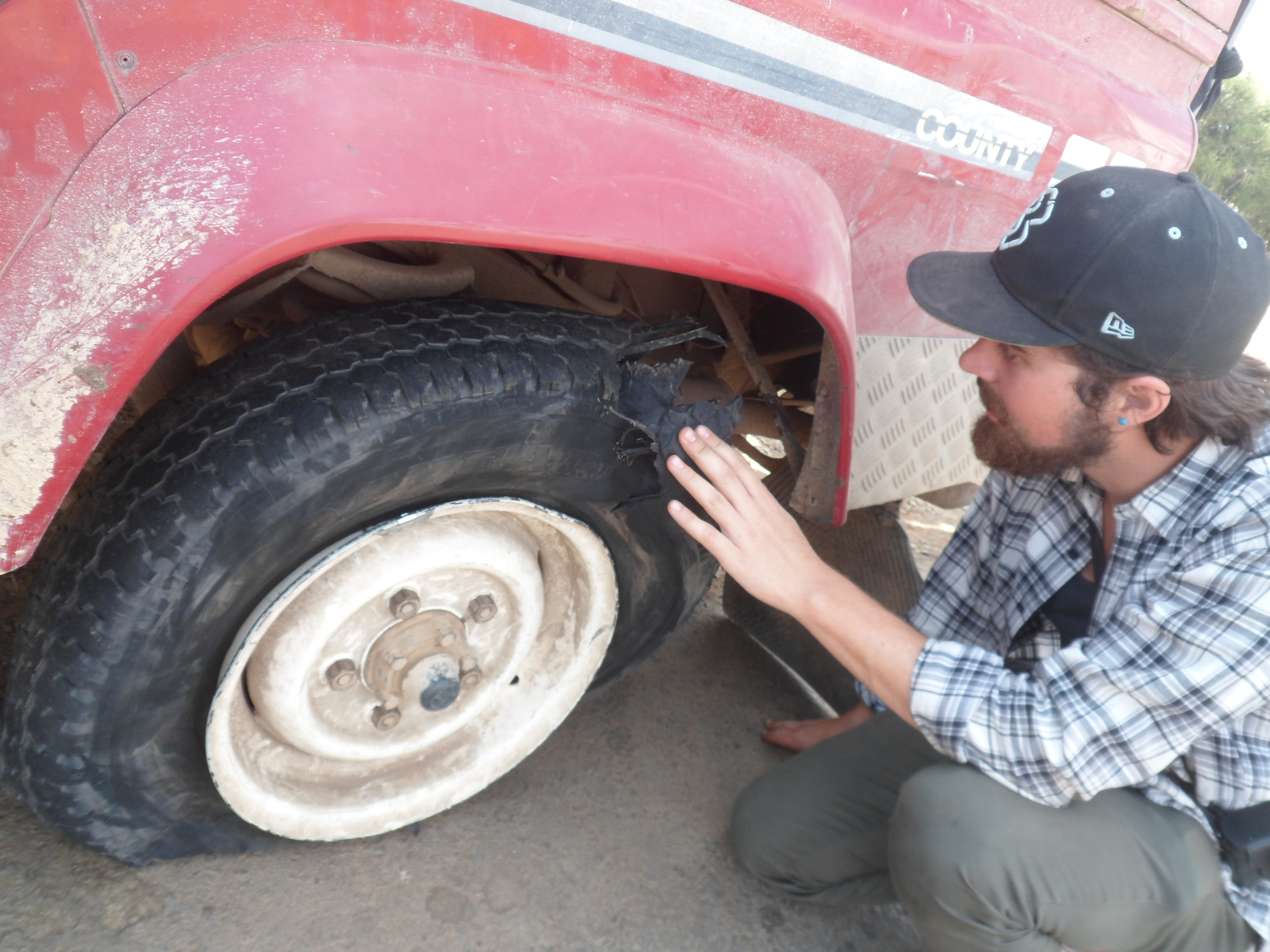
The car jumped and shuddered. I hit the brakes and slammed in a low gear but as I tested a left turn I felt the back of the car slide out. We had a rear left blow out. I stopped breaking and let the screaming engine slow us, before guiding us into the verge. Fortunately we had just finished a run of switchbacks and were on a gentler bend.

When I eventually prized my hands from the wheel, they were shaking. We were on the edge of a village and crowd was already gathering. The tire was red-hot and shredded. A combination of rock-wear, heat and altitude had exploded it. We quickly changed the wheel and tenuously drove on. Any further tight corners were driven slowly, with the uneasy feeling that Tess might fail us.

SAM_1114

It was about time for a much-needed evening beer as we arrived under a canopy of grand trees, by a cool lake, in a place I vaguely remembered. I had been doing a bit of overland networking in the preceding days and there was, at an outdoor table, a group of six awaiting our arrival. Among them was Chris, a well spoken, ‘Our Man in Africa’ sort who was leaving the independent election monitor business and looking for prospects in Ethiopia. He had gone ahead of us from Gondar and, true to character, arranged a full social itinerary, ready and waiting. At the table we met Claire, who was following a similar route down to Cape Town, only solo and on a motorbike. We were bound to overlap each other on the road. We also met Pooja, an Indian fashion professor at the University of Bahir Dar. Over a boozy supper it was suggested that we all stay at hers, complete with a fridge full of beer, wine and a campfire.

The following days were passed in ease at Pooja’s house. During the day we explored lake Tana, the source of the Blue Nile and the ancient island monasteries, each night we would sit up late, sing, drink and play the guitar. Indeed, romance may or may not have blossomed over those balmy nights but the protagonists (if they even exist) wish to remain anonymous.

When it was finally time to go and our tires were fixed, we drove on to Lallibella, the Unesco site of the monolithic churches. We arrived just in time for a massive entry-fee price hike and another puncture, the cause this time being a nail.

The churches, still active with hermits and holy men who largely go about their business, were built throughout the (European) middle ages. Dug out from existing caves or hewn from solid rock, they stand embellished with symbolism and filled with holy treasures. Rich, Dan and Megan explored the twenty odd churches the following day. Bob, who couldn’t justify the $50 entry and I, who had seen them before, had the fun of finding another tire repairman.

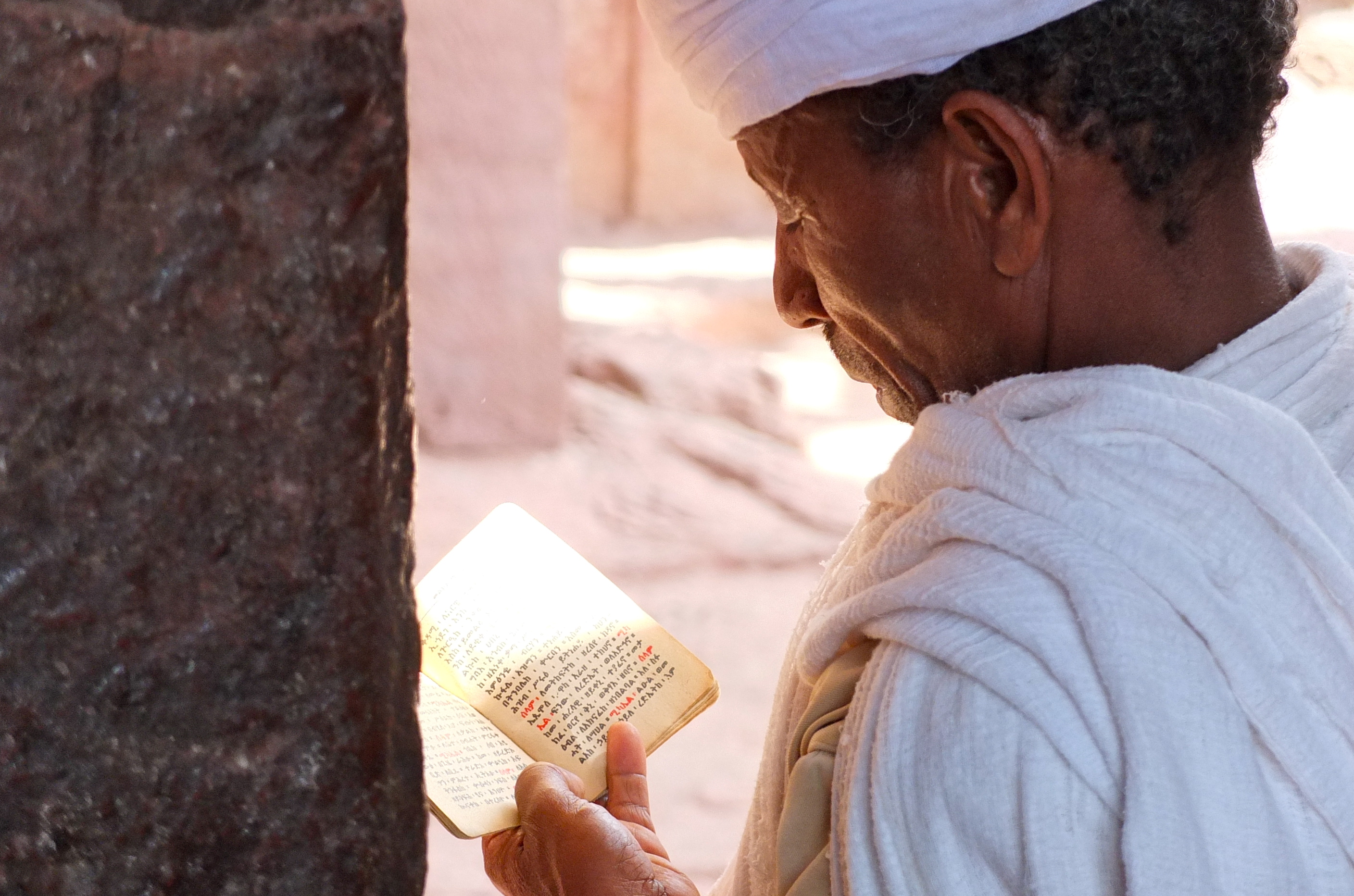
Rudely reading over the shoulder (Dan)

Rudely reading over the shoulder (Dan)

Bob and I picked up the rest of the team, awe-struck and exhausted that afternoon and belted off toward Addis. Rich was serving his term as navigator, the most important decision making role in the car. He decided to cut a large corner off our route along a winding road that showed up on St’ Nav’ (full title: his all seeing, holiness St Navier of Slough). This way proved to be one of the most challenging pieces of off-roading in Ethiopia. With rock scrambles and riverbed crossings all the way up to join the mountain road. We averaged 12mph over 25 miles. One positive was that or Perspex rear window held its own as a well-aimed rock, hurled by a disgruntled villager upon realizing we hadn’t arrived to dole out money. The missile bounced inches from my face.

The following days were road heavy. Megan, who had now assimilated seamlessly into the group as chief finder of un-findable things, had a flight to catch. We took the eastern road along the floor of the Great Rift Valley. Here in the shadow of the escarpment, Arabic culture had penetrated. Camels sloped alongside the road and minarets once again marked the towns.

On the final day before Addis we made camp in a wild, hilly spot. Hidden in the thorns and blonde grass, the stars came out and we made merry (albeit quietly as you are never truly alone in Ethiopia). The Southern Cross was now making a regular appearance in the sky as we headed for the equator. Strangely though, clouds were beginning to obscure the night sky.

The next morning something amazing happened; something that we had not witnessed since three months ago in Turkey. It rained. A cold air rushed up with the scent of damp earth. We watched the modest drops gather on our windscreen. It seemed strange and unfamiliar. We had accustomed ourselves to a dry and rainless world.

We climbed back up to the mountain plateau, following the migrating clouds as they rushed up through the trees. Back at altitude the sun was still bright over gently rolling farmland and hills.

Addis Abeba is not an ancient city like many in Ethiopia. In fact, it isn’t much like the rest of the country at all. It is almost as if somebody has dumped all the components of a modern city, tower blocks and all, haphazardly atop the fields surrounding a palace. That said, there are clusters of excellent bars and restaurants. It is also relatively safe. The young middle classes are really prominent in this fast-growing building site with the nightlife and live music scene is exceptional for Africa.

We smashed through the gates of the Taitu hotel and made a show of parking up, for the tourists on the terrace. We had time for a shower, change of clothes before we headed out to a restaurant for Megan’s send-off meal. After a delicious if slightly rushed meal, we bundled her in to a taxi and waited for the phone call to say that she had missed her flight. It never came.

The following days were a long slog around the spread-out conurbation, sorting out all the things we had been saving up. There were western travelers and ex-pats in an abundance that we had not experienced thus far. We met back up with Claire who was preparing to cross the treacherous Lake Turkano road into Kenya. This mammoth slog of tribe-land and empty wilderness would be madness alone, so she had recruited a convoy. They were heading off the next day to avoid the rains and the Kenyan elections. We were unable to travel with them, deciding to wait for the Swiss and chance the same route ten days later.

Over lunch we met the other overlanders. In a younger Defender, were two younger Brits, Walter and Freddy who were in the midst of a blown head-gasket fiasco. We also met three Germans in an immaculate Land Cruiser. On of them decided to travel in our car for a while before she headed back to Cairo. Her name was Estella.

SAM_1067

In an outdoor café where the live reggae blared out, we met Colin, a friend of the Khartoum French girls, world-class saxophonist and all round hero. We moved in with him. It was in Colin’s house that the newly formed group hatched a plan to visit the unrecognized republic of Somaliland.

The Dawn of A New (Puncture Prone) Age

 We had developed a bad habit of Samosas. These little bundles of food poisoning sit for an unknown length of time in shops, quietly incubating before a hungry traveller, looking for instant gratification decides to take a chance. Rich had taken ill. After a long, draining day of Timkat festivities, Rich was put to bed in the tent whilst Dan and I hit the town. We met our Swiss overland companions then picked up Bob. He had managed not only to cycle the long, mountainous journey from Khartoum, recover from the exhaustion, heat-stroke, injuries and illness but also to befriend half the Rastafarian community of Gondar.

The streets of the city were alive and merry. We had found a local place, which sold beer at a negligible price and a popular dance bar. Ethiopia has opted out of the cultural influences of Europe and America that so much of Africa aspires to. Instead they have their own music, films and dances.* We made the bad decision of ordering food at the dance bar. During our two-hour wait for food, what had been a peaceful, sit-down restaurant erupted into a heaving nightclub. A live band blared out the ubiquitous rocksteady beat with wandering Casio trumpets and vocals that leapt across scales. The room filled with a blur of flamboyant uniforms and traditional dresses straight from the festival. All around, shoulders bobbed at a speed we were unable to replicate. The Ethiopian dance style represents courting birds of paradise, with men bouncing and puffing around women who shake their hair and shoulders. Through the maelstrom came a determined waiter with bowls of pasta held high. Squatting low on stools, we ate what we could beneath a thrusting canopy of dancers before a man dressed as a lime-green silk matador drunkenly flung himself across our table, scattering what was left. We abandoned our supper and entered the fray.

DSCF3013

The following morning, Rich awoke fully recovered from the grip of the Samosa bug. However Dan was now suffering the combined onslaught of food poisoning and a fiendish hangover. He wouldn’t leave the tent for several days. I was somewhere in between, hungover and tired from having spent most of the small hours explaining to a girl that a dance, regardless of its talented execution, does not mean marriage is inevitable. I was not exempt from driving to pick up our friend Megan, bright and early, from Gondar airport.

Megan is so far the only person to brave the African leg of the expedition. An old school friend, Cornish resident and fellow Perraner, not only was she coming out to Africa but enduring two weeks with the expedition. I was a little worried at what she would find.

She would be a new species in an ecosystem that had taken a long time to evolve and equilibrate. The three core members of the expedition had been on the road since the beginning of October. We were into our twentieth country, un-separated from our vehicle or each other. Those clean cut, Cornish doctors had become a tangle of uncut hair, moustaches, running jokes and complex systems. Every position and aspect of the car had evolved a name; we practically spoke a different language when driving or packing. We were probably a little too comfortable with crowded, dusty streets, the intensity of arriving in every village as a celebrity and day after day of bush camping.

I had time to down a couple of superbly strong Ethiopian coffees before we drove to the airport. I managed to fit a dramatic passport loosing-finding fiasco into the hour we had to wait for the internal flight. Megan arrived. During the excited greeting, she disguised her reaction to the state of Tess and us expertly. She was able to catch the last big day of processions and celebrations.

The following days were spent preparing for our onward journey and waiting for Megan’s bags to arrive. They had probably gone through more countries then the expedition. In her luggage however was an Aladdin’s trove of marmalade, marmite, letters from loved ones and single malt without which the expedition would have certainly ground to a demoralised halt.

The city returned to relative normality, Dan stayed in his tent in a shady spot in the garden, exhausted by his malady. He would only whisper faint acknowledgments of our presence during the day. By night, he would babble, laugh or cry-out in primal terror at whatever fever-fueled illusion taunted him. Meanwhile, I had by the skin of my teeth avoided betrothal to a daughter of a powerful Gondar family. Just as the situation was really escalating – having met the mother, brother, sisters and stern, three-piece-suit wearing father – I was dumped, apparently due to my unpredictable future plans and non-committal behaviour. It was time to leave.

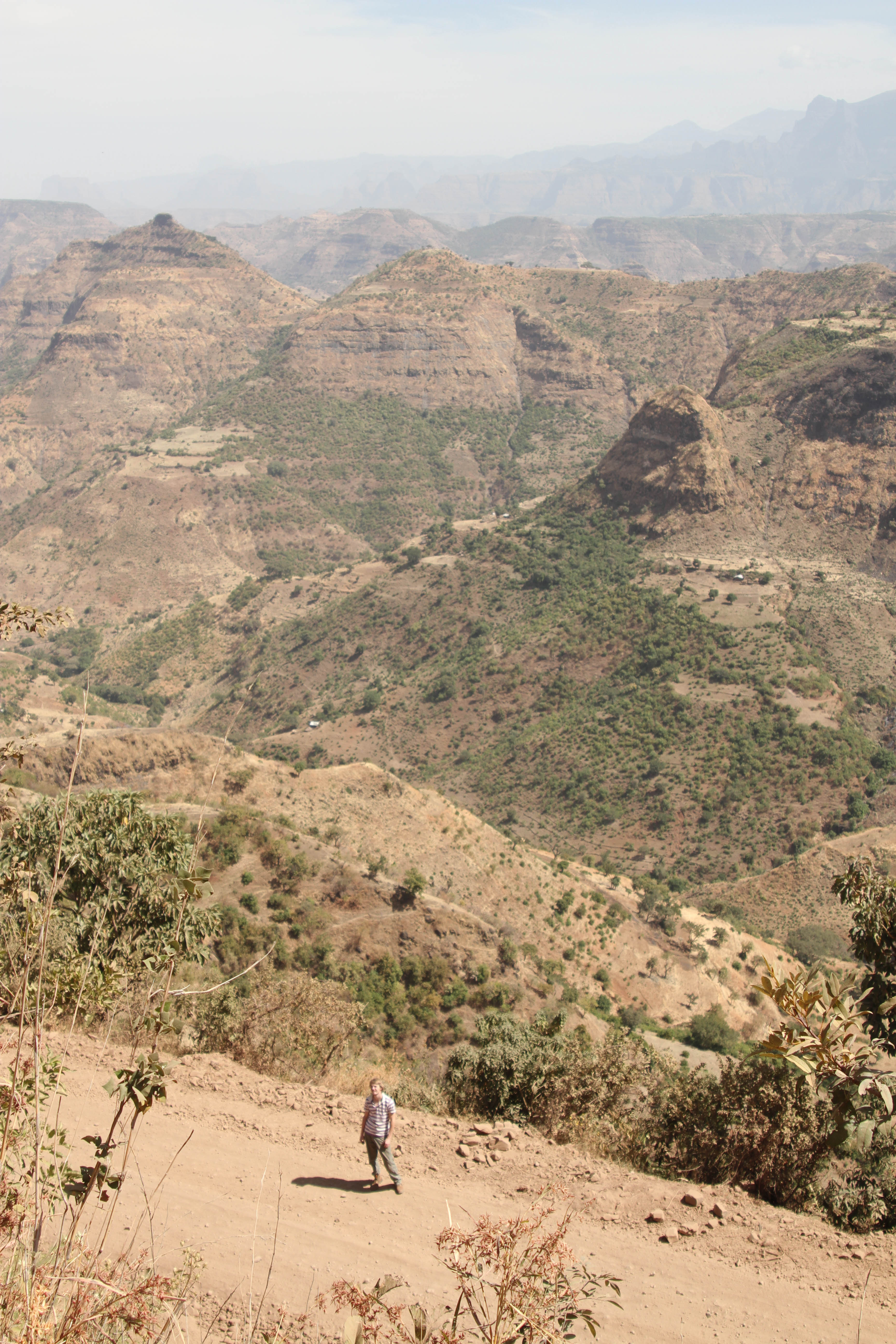
As I have said before, the Great Rift Valley, that runs the spine of east Africa, has some pretty serious geography going on. The Simien Mountains are where the Rift Valley is at its riftiest/most-rifted/riftigenous; the bigger brothers of all the other Ethiopian mountains; ‘The Playground of The Gods’. Most amazing is how the land here plunges in great folds down to bellow sea level in the volcanic Danakil depression.

Our venture into this lofty playground had a few ill-fated turns. As we had our own car, we thought we could keep costs down and only hire a scout, without taking a guide. All of the scouts are old war veterans who fought against the Derg and were allowed to keep their guns. The scout we picked up was an ancient, arthritic soldier who spoke no English.

We spent a chilly night in Debark, the last town, before setting off early the next day. Our car was a modest six with the scout, Megan and Bob, whose bike we strapped to the roof. A few miles out of town we took a steep track that fell off the edge of the range. Although we had started above 3000m, we all had a nagging feeling about heading down several monumental cliffs, rather than up into mountains. However there didn’t seem to be another road and our scout sat peacefully in the front, as one would expect from a man going along his usual route.

DSCF3177a

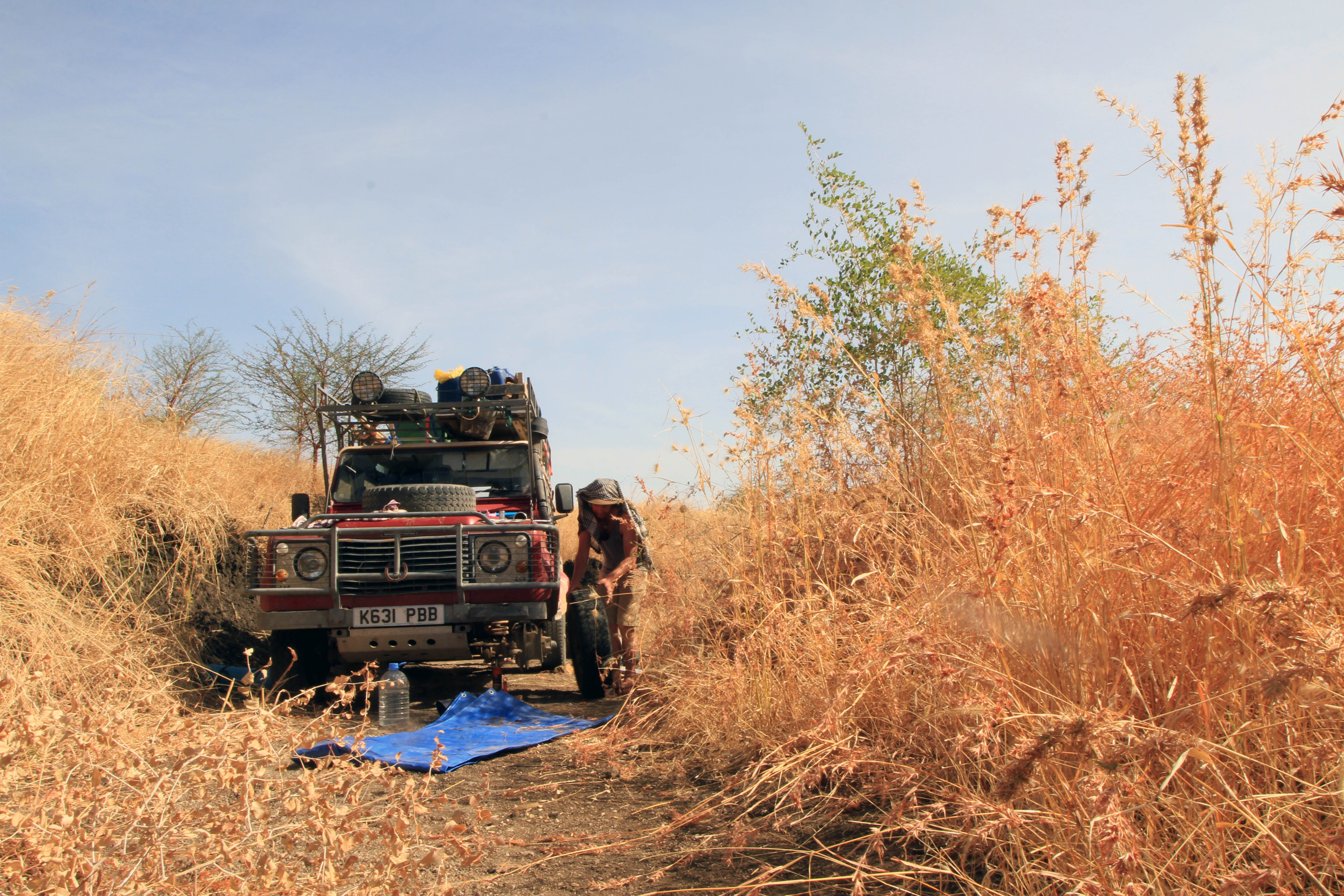
After four hours winding down rocky paths only really fit for mules, we had a puncture. As the countless, would-be assistants melted out of the landscape to stare at us changing the wheel, I craned my head up at the wall we had dropped down. I thought I’d better just check with our guide. He tried to escape the conversation when I asked for the name of our destination but I noticed him flinch in realisation at ‘Sambikir’ the name of the first camp. He shrugged his shoulders and made an elaborate show of shooing away the locals with a pointed AK47, as if to highlight that he was a guard, not a guide. This façade of ignorance was fooling no one. He caved under further interrogation to reveal that despite being only a few miles as the crow flies from our ultimate destination, a couple of those miles were vertical. We would have to go back to the beginning. This marked the start of a time I would like to call ‘the flat tyre era’. The rest of the day was spent with the five of us (plus gloomy scout) crammed inside Tess, climbing back up to the start.

It was dark when we limped into camp. We had salvaged some of the day by finding and following a thousand strong troop of Gadella baboons, the largest and most peaceful of their kind. We had also endured a further puncture, using up our second spare. We found the Swiss camped in a grassy clearing overlooking a sheer valley. Over supper they told us that they wanted to leave their car hidden in the mountains in order to trek away from the road. They asked us whether we could find it and drive it on to the third campsite, where they would pick it up a day later. We readily agreed. The plan seemed flawless.

The following morning we awoke to find golden sunlight kissing the peaks and Tess listing over a third flat. Our Toyo all terrains that we had bought second hand on e-bay had held up well until now, but seemed to be failing on the rough mountain roads. Rich decided to attempt fixing the tyres in the bush and look after Dan. Meanwhile I would take a trekking party of Megan, Bob our confused scout to see the waterfalls. We would try and locate the Swiss’ car (a day’s walk ahead) then await the Landie before heading in convoy deeper into the range. Over breakfast, as if to mark an omen, a Black Kite circled, then dive-bombed Megan as she prepared breakfast, making off in a hiss of feathers with a doughnut in its talons.

DSCF3199

The morning’s trekking was deifying; worthy of a power ballad. We walked along the edge of oblivion, tumbles of highland, tiny farms, houses and soaring eagles all miles beneath us. By lunchtime we were at the waterfall, a great granite cleft, disappearing into the shadows of the mountain it had hewn. Tiny, we peered into empty air. The sun caught the backs of rising vultures. Neither sight nor sound could be glimpsed of the bottom. We trekked on to the road to wait for the support vehicle and eat a modest lunch of Samosa roulette.

By three, we were faced with difficult decision. The car had not arrived and was probably back at first camp. The Swiss-mobile was hopefully a few hours up the road. Our bag only had a few jumpers and a coup of water bottles. We decided to take a gamble on the support being close behind and to push on and up to find the car. As long as we stayed on the road, we couldn’t miss Dan and Rich.

We trudged for a further two hours along a high plateaux and past a village, gaining altitude all the way. There was still no sign of the car. Our guide, who seemed to be suffering, was becoming very anxious as the shadows grew longer and a sparse mountain chill began to bite our sunburnt cheeks. It wasn’t really possible to explain our complicated plan to the scout, only keep repeating the name of the point Dario had hopefully left the car. Worryingly, his directions kept changing. We had to keep going.

By six, we were tired and hungry. I was silent with worry. Over each horizon we would scan with binoculars for the silver of a hidden vehicle before heading to the next viewpoint. There was no sign or word from Rich, Dan and Tess. Finally, as the temperature was really dropping, we spied the car.

The group of locals who had been paid to watch it were alarmed when a trio of farangis marched across their field and fell upon the car, ravenously ransacking the vehicle for food and warm clothes. We had no choice but to drive the final ten miles to Debark (the third camp). The road was extremely treacherous and it was my first time in a left hand drive car. Our poor scout wisely did not release his white-knuckled grip of the handrail for the whole journey.

After navigating several precipices we rolled into the final camp. The low light was electric pink. Ravens and vast Lamergiers swooped and crowed around the cluster of buildings. Otherwise the thin air was silent. We watched sunset with an eagles’-nest panorama. The high mountain moors were wild and cold above us. The song of the Simien wolves drifted just beyond recognition. That night we spent our meagre funds on a hot meal. We had no warm clothes and no sleeping bags. The car had a roof tent, a towel and a thin blanket. Temperature dropped to around minus five as we huddled together for scraps of sleep.

IMG_6822

Meanwhile, Rich had been thwarted by a series of cheap Chinese pumps, which broke in quick succession. He was forced to hitchhike back to the town, rolling two wheels to be repaired. He salvaged his situation somewhat by infiltrating the dinner of a Belgian tour group and charming their daughters. Dan spent the night alone in the wilderness with just his delirious nightmares for company.

Our delivery complete Bob, Megan and our broken scout were forced to hike back until we could flag down a vehicle. We eventually jumped into a road builder’s truck filled with the mountain’s commuters. In the trailer we held on to wherever we could as the driver accelerated around sheer-sided corners with complete disregard for potholes or his suspension. Megan, Bob and the scout kept their heads wisely inside the trailer bed. We had all seen the skeletons of trucks and holes in the barriers that mark out the Ethiopian roads like milestones. Bob had even witnessed the last expressions of a mini-van full of passengers as they left the mountainside on two wheels. I remained standing and planned how to jump out and roll, were we to go over.

Today the driver had prayed sufficiently and we arrived back at Tess to be reunited with the complete team. We headed back to Gondar to recover.

Return to Abbysinia

Bulletin: We have finally decided upon a name for our Land Rover. Tess, short for Temeraire. Named after the Turner painting of the old warship being dragged in for scrap at the end of its days, temeraire (where we get the word temerarious) is French for foolhardy bravery. We felt all these things summed the expedition up.

IMG_7046

Like each city before us, the map of Khartoum gradually gained meaning. We painted the birds-eye roads and rivers with minds-eye pictures, adding personal landmarks. The GPS stayed locked in our central console now, as we instinctively navigated to the best coffee in the leafy diplomatic quarter or to the reliable mechanic in the ramshackle industrial district (dust being the operative syllable).

Moving on left a nagging question as to the futility of all this knowledge, should I never return to this particularly welcoming of cities. We had a grounding not only in the geography but in the language, the mannerisms and customs; all essential for turning survival into enjoyment. We had friends here. Was all this now to be reduced down to a few choice anecdotes or an occasional feeling evoked by a mood or smell? This is a question that has, for a long time, harassed me. We accumulate so much experience that we will probably never have the chance to use. However, in an uncertain future, you can never appraise the key piece of information you will need. Also, it’s amazing what comes in unexpectedly useful. So for the meantime I will continue to assimilate everything memorable enough to remember. And – as if to affirm this decision – here I was, returning to Ethiopia after two years, equipped with little useful knowledge remaining, but with a constant sense of Déjà-vu.

At Khartoum, The Blue and White Nile meet (although the two great waters travel onward for several miles in the same bed, coyly eyeing each-other up before finally merging). The team had decided that for continuing upstream, the smart money was on Blue. The source of our chosen river lay far away (and up) in the mountainous enigma that is Ethiopia. Incidentally, the team was now down to the original three. Our Swiss support car had driven on ahead, Bob had cycled off into the desert with 500ml of water and a bag of dried pasta and our French hostesses had chosen continued employment over the romantic life of an African Overlander.

Light and efficient, the expedition struck South-East. Each day’s drive saw the Sahara gradually change into scrubland, then savannah. The land filled up with huts, tracks and people.

The grassy bush was far overhead as we steered off for our final camp in the remote borderland. The dense vegetation was thick with nature and the suggestion of human activity. We hid in a dry river bed. As the sun set, I snuck off alone, using the riverbed as a path through the imposing grass and vicious thorns. I left the safety of the riverbed to photograph a pair of Hornbills, buoyant in the cooling air. Keeping a vague eye on the route I climbed up a hill to watch the sun-set.

As I sat under a flat-topped tree, the hills reddened with the scything clouds. A flash of improbable cyan caught my eye. An Abyssinian roller glided between trees. I followed it in the tunnel vision of my binoculars, followed it across a smudge of dark trees and past the wide-eyed shock of a human face. I was being watched with a transfixed but unsure grin. Nearby, there were other dark figures in the gathering shadows. No stranger to trespassing in the English countryside, the sensible, mature thing to do at this point would have been to casually wave, acknowledging discovery and then begin an exaggerated act of looking for a footpath or disobedient spaniel. However in my short spell of African solitude, I had lost perspective. I legged it over the brow of the hill. Diving into a beastly thorn-thicket, I hid, scanning the horizon. I was not obviously followed.

Back at camp, Dan and Rich were sitting on the roof serenely sipping coffee, trying to ignore the frequent kamikaze cricket face-strikes. I rolled out of the bush, wide eyed and grazed, much to their mirth. If we were watched that night, we were blissfully unaware. I like to think that back in a village in a forgotten corner of Sudan, a similar story is being told about our brief encounter.

Stamping the chassis  (Photo: RWH)

Stamping the chassis (Photo: RWH)

The following morning, still hidden below ground level, Rich became acquainted with the dark and delicate art of chassis stamping. Not having a chassis number in Africa is not an option as our time in Egyptian captivity had demonstrated. Nobody in Khartoum was prepared to stamp us without a letter from the police, who would certainly confiscate our contraband car, so we were forced to take matters into our own hands.

Many African borders are arbitrary, difficult to define lines, representing a gradual merging of cultures or a post-colonial carve-up, dividing kinsfolk. This is not the case for Sudan-Ethiopia. The tapering straight road was covered with people, carts and livestock. In the distance the border stood like the finish-line to a chaotic race. Beyond it rose the highlands. As usual, crossing it involved a convoluted precession of customs checks, stamps and above all, waiting. Our new chassis number was inspected, passed without a second glance and we were through to Ethiopia.

In an instant, we had traded semi-desert for fiercely undulating stacks of fertile earth, the long straight asphalt for a road that climbed and wound for hours before shearing away, and a sparse and easy Islam for a teeming and ancient Christianity. The last time I had visited the country, studying in a remote hospital, it had been in rainy season when all the mountains were butcher’s-grass-green and heavy with clouds. Now the fields that covered all the available flat ground were bare and flaxen, the mountains were naked and striped in blood reds, volcanic blacks and sandy yellows.

The switchback turns slithered under escarpments and over passes. Villages were frequent, wooden houses and thatched huts that lined a road used more as a common space for people and livestock than a conduit for vehicles. Rural Ethiopians (95% of the 90,000,000 population) have little to no concept of road safety or even how traffic functions. We braced ourselves for each village, donkeys, cattle and goats lurched across the road, docile until realising the car was behind them, then stood rigid in terror or bolted unpredictably. The people behaved in a similar way. Watched by the entire town with neutral stares, the innumerable children chased us with the cries of ‘You! You!’, ‘Faranji!’ (a slightly derogatory cross between foreigner and stranger) or just threw stones. Women, a species we dimly remembered from before Egypt and Sudan, were as confident as the men. Each time we stopped the car, a crowd would grow and the windows would be darkened by staring faces and touching hands. Each interaction was a blank canvas, smiles and frowns being quickly reciprocated. One theme was consistent, everyone expected a handout of money.

IMG_6748

That night we tried to camp in a hillside forest. Driving off a troop of unwelcoming monkeys, we sat on the roof of the car, gazing over the evening vista and had a beer, an actual, legal beer. However our the peaceful solitude we had become accustomed to in the Sahara was soon interrupted by people emerging out of the forest. We mistook one man who was particularly keen to meet us as the owner of the land. In a drawn out misunderstanding we fed and watered this hermit who slept by our fire before wandering off in the morning, taking my towel with him.

To gain some understanding of the people who inhabit these highlands, they need to be put n historical context. Civilisation may well have begun here, tracking up the Nile. Judaism and then Christianity took root here before most of the world. Islam surrounded, but never significantly penetrated the mountain plateau. Cut-off and surrounded by enemies, the kingdom of Ethiopia forgot the world and in turn was forgotten. The outside was denied a story of centuries of holy emperors and warring dynasties. When they were rediscovered, a feudal system of Nobles, priests and endless peasants was still fully intact.

In fact the Empire remained un-colonised and resistant to change until events overtook it with the Italian invasion of 1936. Liberation followed soon after with the enthralling Emperor Haile Selassie returning from exile in Jamaica (where he had inadvertently founded Rastafarianism).  Despite his international appeal he failed to spot the need for reform and was unceremoniously ousted by the sinister ‘Derg’. This communist military council was highly oppressive, mismanaged the economy and diverting the much of the international aid Ethiopia is famous for receiving, into the military.

The bloody civil war that removed the Derg created a crudely democratic federation of states who struggle to see eye-to-eye. Throughout this time Ethiopia has been at the sharp end of international aid: large short-sighted projects doomed to fail, food handouts, and money which disappeared into the beurocratic ether. As a result of this complicated history, the Ethiopians are themselves complicated. Much of the country remains ‘feudal’, the educated classes and the clergy sit atop an expanse of semi-subsistence farmers living as their ancestors did. Probably a hangover from the Derg, there are layers of government officials, entitled and stifling change. Fiercely proud of their isolated history, they are prone to xenophobia and anger over the wealth discrepancy between them and the ‘Farangi’. The malignant effects of last century’s blind aid are all too apparent. Tourists, who no doubt have contributed to the problem, are expectantly mobbed in every village. Cyclists, as our friend Bob found out, are stoned.

IMG_6711

All this said, when befriended, Ethiopians are sharp, subtly humorous and take hospitality very seriously. This depth of character takes time to break through to, a big problem for our fast moving expedition. This is why the city of Gondar, where we would spend over a week, was a nice break from our constant migration.

Gondar is the old capital and holy city of emperor Tewodros. Centred round a grand castle, its cobbled hillside streets link the countless churches. We had arrived here in time for the greatest show in Ethiopia: the festival of the Epithany, or Timkat. Here, during four days of celebration the tablets bearing the commandments from each church are baptised in the pool and moved in an enormous procession back to their churches. Here we were also expecting to do two other things: visit the Gondar (Ethiopia) Eye Surgery (GEES) project to which we have been donating half our sponsorship money and to join up with Megan, a good friend who was bravely coming to visit from Cornwall.

We set up camp in the shady, lush gardens of the grand but decaying Terrana hotel. Before the festivities began we were able to meet up with Dr Asamere, consultant eye surgeon. Over lunch we talked at length about the state and aspirations of the project but also about history, culture and football. He offered not only to take us around the eye hospital but also to show us the highlights of Timkat.

GEES was set up by a British eye surgeon, Sandy Holt Wilson, who identified the need for the project whilst working in the region. Starting small, GEES has supported a new eye hospital, providing a consultant ophthalmologist and equipment. It is also now training ophthalmologists and specialist eye nurses setting up a new teaching facility and library. The burden of disease (largely blindness from cataracts, infection, deficiency, injury and diabetes) and the area covered is huge. However the project is growing slowly but realistically toward making Gondar a centre of excellence for eye care. There is a real feeling of progress at the hospital.

The excitement had been building like a thunderstorm when the first parade broke. In the main square, hundreds of pilgrims clad in pure white shawls followed a blaring procession of music, archaic guns, swords, jangling umbrellas, cracking whips, intricate hairstyles and harlequin uniforms of outrageous silk. Every village, church or civic institution seemed to be putting on a show.

The following morning, we met Dr Asamare down at the Fasilidas baths, a fascinating, fortified swimming pool like structure build in the 1600s. The first tablets had been baptised and the waters blessed. The sun-dappled waters writhed with hundreds of bronzed bodies, merrily splashing in this holiest of leisure facilities. We followed in the path of the tablets in a procession of thousands that dwarfed the day before. Carnival floats, co-ordinated dances and bearded holy men carrying staffs and ornate crosses were now added to the mix. Unfortunately, Megan’s plane was grounded in snow back in Bristol, a concept that was difficult to fathom as we sought refuge in all available shade. However, she was touching down the next morning for another big day of festivities.

Honesty and Integrity (of doors)

Rudely awakened by the burning sun, we pressed on. We watched the kilometres slide past, the landscape intermittently punctuated by ancient pyramids. Even with a solid road it took three full days to cross the desert, North to South. We arrived into central Khartoum almost unexpectedly. In the dead of night the suburbs gave way to the deserted streets, ramshackle buildings, and clouds of swirling rubbish of the city centre. We were exhausted and underfed, which are sensations never conducive to a positive state of mind. We went to bed with our hackles up, worrying about our car on the street outside.

Image

Ancient pyramids rise out of the Sudanese desert. (Photo: RWH)

Until now our experiences in Sudan had been universally positive. In fact, we had relaxed more in this country than any other since Greece. More than once we had been lax. On the first such occasion, a member of the team who shall remain nameless (Rich) managed to leave the ‘People’s Folder’ containing three passports, carnet de passage, US dollars, immigration documents, and generally everything we hold dear in a market stall in northern Sudan. On the second such occasion, a member of the team who shall remain nameless (Rich) managed to leave the ‘People’s Toolbox’ by the car on a busy street. On all such occasions we had had our missing items returned to us within hours, or frantically retraced our steps only to find our precious belongings in the grinning hands of the stall owner, with offers of tea and chewing tobacco (generous, but sadly a futile offer in the case of the latter!). Our arrival to Khartoum in such a state sowed the seeds of doubt in our minds, and we wondered if all the doubtful looks and raised eyebrows when we mentioned Sudan in conversation at home had been justified.

We were pleasantly surprised when we awoke in the morning. Bustling and colourful, the streets had transformed into a melee of trade and commerce which felt positively relaxed after the ruckus of central Cairo. We breathed a sigh of relief and went about our business feeling safe and welcomed. We were up and on a mission: car repairs. After a small fiasco where our GPS entertained the belief that it resided in Mali, we made our way to the industrial car area. Here shacks baring the emblems of every car manufacturer imaginable tripped over each other into the compacted earth street. Cannibalised skeletons lined the roads, their stripped chasses serving as benches for overall clad mechanics methodically putting the world to rights over chai. A donkey passed, pulling a cart piled high with modern plastic car body panels, the cart its self supported by a Land Rover Series II axle with hand-made wooden wheels. Nothing is wasted in this country.

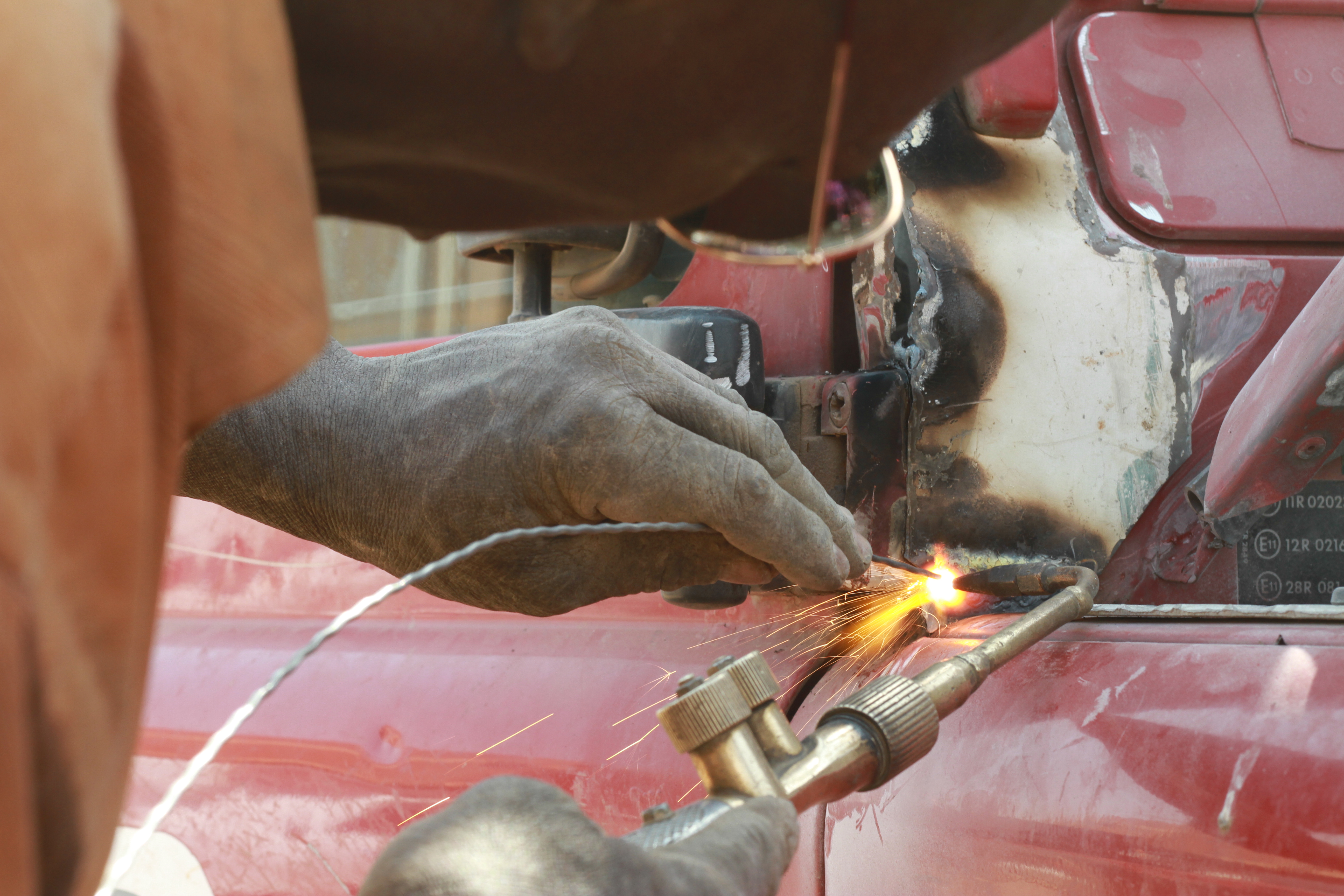
After much well-meaning small talk, we found Abdullah, an angle grinder enthusiast with hands made of elephant hide, who happened to also have talents in the area of bodywork reconstruction. Explaining to him the concept of repairing significant portions of our rotten bulkhead required two rounds of incredulously sweet tea, three separate interpreters, much pointing, and most of the morning. It requires a hearty amount of trust, desperation, or perhaps stupidity to let an overly zealous Sudanese man with a blowtorch anywhere near your belov’d Land Rover, even if it does look like a rusty shack. We sat in the sun for two nail-biting days, watching Abdullah slowly reconstruct the wounds he had inflicted on the car, affirming the faith that we had placed in him as he did so.

Landy Patching (Photo: RWH)

Landy Patching (Photo: RWH)

Our doors were giving up the ghost, and even our complex system of plywood, brackets, and bolts was struggling to hold them together. We found an old Land Rover in the back of a garage who had sadly passed on, and with Abdullah’s help negotiated the salvage of her two back doors. Rust doesn’t exist as a concept here, and they were solid. A further days work saw them hanging proudly on our steed, brightly discordant but gloriously unyielding to rain or rascal.

We were invited to stay with three young employees of the French Embassy in Khartoum. Manicured gardens and tasteful buildings lined the streets of the expat district, and we felt uncouth as we growled our way towards their house in our newly piebald monster. We were ushered into a cool, spacious flat with soft accents and a hint of perfumes long forgotten. We had stepped into a world of saussison, rich chocolate, and Pastice. Conversation was animated, company excellent, and accommodation luxurious. We couldn’t believe our luck.

The expatriate scene in Khartoum turned out to be a close-knit international community. Given Sudan’s political instability, the majority are young workers without families. Alcohol is strictly illegal in Sudan, with the disobedient facing fourty lashes* as punishment. However, a strange agreement exists where embassies arrange regular imports of liqueur for their employees while the authorities look the other way. These two factors results in a strange and vibrant social scene which harks back to the era of American prohibition. The gatherings are highly lubricated, all the more fun because they are forbidden.

Despite the fact we have managed to talk our way across two of the hardest borders of our trip with only half a vehicle identification plate and no chassis number, our apprehension grows that at some point we may encounter a competent border guard. As such, we spent a memorable morning hunting out the shadier car mechanics in Khartoum and trying to persuade them to engrave our car. We were surprised at their absolute refusal. Residents seem to be terrified of the government’s retribution here, giving the country a very safe yet slightly stifled feel. After much hushed discussion we recruited a local chap and set off in a tuk tuk in search of our own equipment. We eventually found a set of roman stamps imported from Germany. We would have to do it ourselves, and soon, before Ethiopia.

*Interestingly the original Aramaic words for ‘fourty’ and ‘many’ were the same, leaving this particular punishment open to interpretation.

The Road to Khartoum

It was with nervous excitement that we made our way from the village of Wadi Halfa, Sudan’s northern frontier town to the port, although we had come to the conclusion that this was a rather grand title for what was in fact a single jetty and crumbling customs building. Wedged into the back of a tuk tuk we watched Africa’s biggest man-made expanse of water consume the visible horizon as we approached. I tried to imagine what the ancient kingdom of Nubia, long drowned by Nasser and his controversial Aswan dam, would have looked like. Suddenly I understood the sadness of these people. Their heyday more than two millennia past, the Nubians were more recently divided by the arbitrarily drawn international border of Egypt and Sudan, and then drowned by Egypt’s developmental progress. The strength of identity both sides of the border had surprised us, and reminded me of my home and the fight to maintain the Welsh culture and language.

Thankfully the soft sand only causes a brief hitch in the desert! (Photo: RWH)

Thankfully the soft sand only causes a brief hitch in the desert! (Photo: RWH)

In the distance we could see the two cars perched atop a rusty barge, barely visible under a huge mound of assorted goods covering every inch of the deck. My Swiss companion and I perspired our way down the jetty after much prevarication and tea drinking in the customs building. We slowly cooked in the early morning sun while the mountain of fragile wares covering our cars was unloaded by a squadron of unconcerned jumper-wearing locals. Eventually we were called upon to unload our cars. There was much frantic gesticulation and as we teetered our cars precariously down narrow metal ramps several meters above the water. A score of Arabs yelling passionate directions and waving limbs only served to make things worse. Wheel by wheel, we crept to safety. The rotten concrete of the jetty moved an impossibly large amount as the barge was slammed against it by the chop, yet it felt solid and secure to us.

Departure was a joy. We had read many accounts of the treacherous and difficult road through the 1,000 km of Nubian desert to Khartoum. There were historical reports of travellers perishing having strayed miles off the supposed route and becoming stranded in soft sand. We were almost disappointed to find a perfect strip of newly laid tarmac leading us south, another African highway transformed thanks to the Chinese. We soon consoled ourselves however, remembering the challenges of desert driving, and how they are wonderfully satisfying to tackle when optional. Driving in convoy with the Swiss for the first time, we drifted past terracotta dunes, gravel plateaus, jagged hills, and towering stacks of jet black rock. Steering was an intermittent occupation for the driver, required only to avoid the odd donkey and cart. Occasional puffs of diesel smoke on the horizon gave testament to the seekers of the rich resources of the desert, where gold, gypsum, and a whole host of other treasures lie in abundance.  Suddenly the laying of a thousand miles of asphalt seemed a cheap way of acquiring extensive mining rights in this resource rich desert.

The temperature climbed with the sun. Windows agape, air conditioning a concept of the distant future, we forced the Landy on through the wall of heat. We thanked our fortune as we watched the mercury climb to balmy thirty seven that we were here in winter. Occasionally a green line appeared on the horizon, and we knew the road had drifted close to the nurturing moisture of the Nile. The longest river in the world, this huge body of water provides an artery of life blood to thousands of miles of barren moon-scape.

Through the mirage we saw a hunched figure drawing nearer. Emaciated, caked in dust, we recognised Rob, our friend from the Aswan-Wadi Halfa ferry, sitting head in hand in the midday heat. Made of true Lancashire grit, this 23 year old man had cycled his Grandfather’s bicycle from Rotterdam to his current location, 600km shy of Khartoum. Two days ride and 200km away from the nearest town, he was battling a worsening knee injury and dwindling supplies.

Exhaustion bites in the midday sun; Rob Lowe, British cyclist struggles on in the Nubian desert. (Photo: RWH)

Exhaustion bites in the midday sun; Rob Lowe, British cyclist struggles on in the Nubian desert. (Photo: RWH)

We hopped out water in hand and held an impromptu orthopaedic consultation in the shade of the car. It sounded to us as though rest was going to be needed before he could continue riding. His eyes flashed defiantly as we suggested he jump in the Landy with us until Khartoum. We prized his bike from his reluctant hands as he begrudgingly caved to our persuasions. We consoled him with promises of food and camaraderie as we emptied the car onto the road in an effort to repack. Rob’s bike Alan, named after his original owner, was absorbed by the roof rack and we were on our way, our ranks bolstered.

The realisation that this journey would encompass New Year sent us looking for supplies in Dongola, a market town shielded from the heat of the desert by the cooling embrace of the Nile. We negotiated our way through the forest of cardboard-roofed market stalls, first wondering at the cost of bread, then perplexed at an apparent run on the price of the tomato. An investment of £1 at the Lord Hotel paid dividends in sleep, and we set off early in light of this windfall. On a particularly remote stretch of road we set a bearing and bounced and slid our way into the wilderness. Overloaded, top-heavy, inappropriately shod with comically small tyres, the Landy powered on defiantly. We were moved with pride.

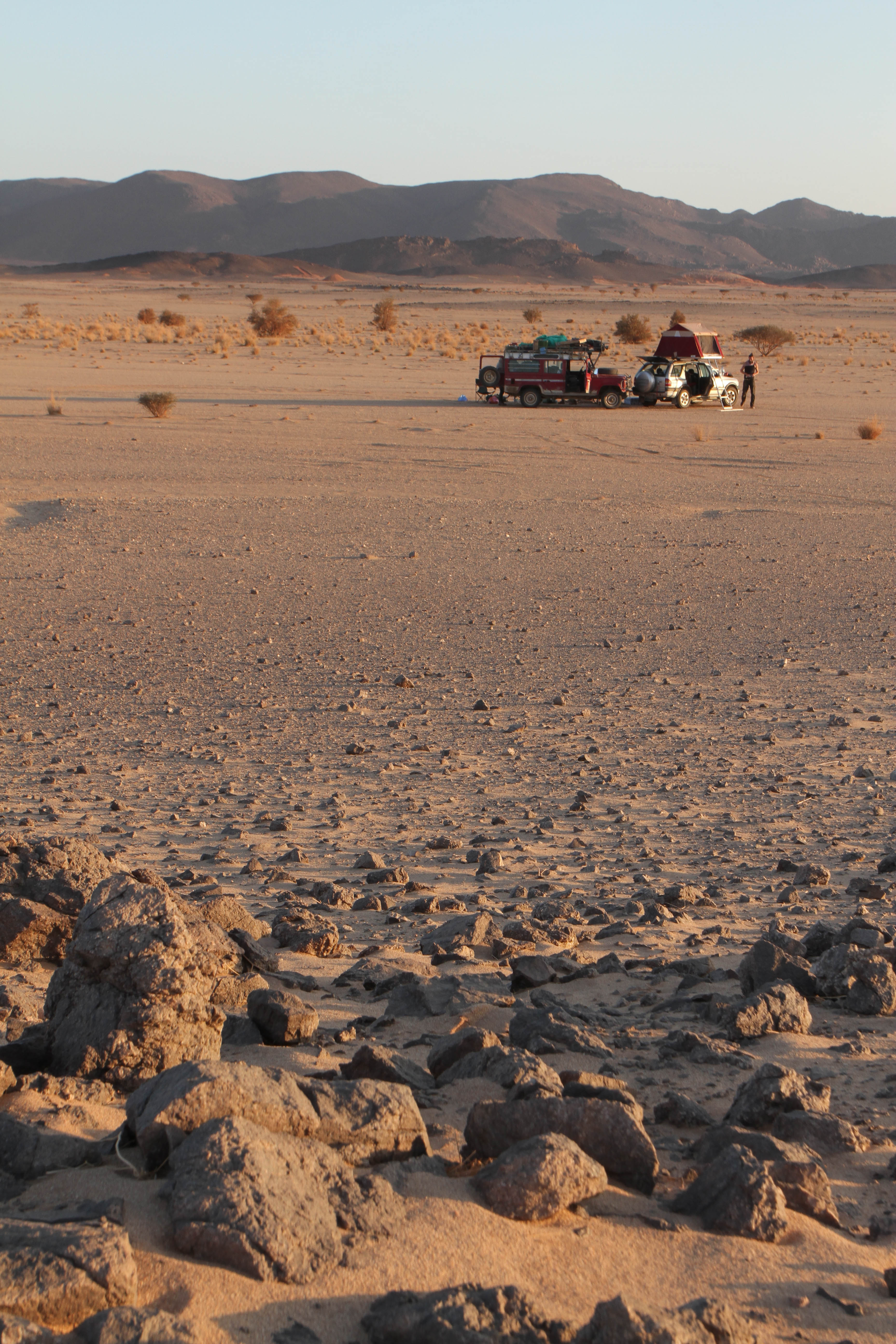
Eagle-eyed, Bass led us towards a caravan of wild camels in the distance. We followed their path to a small oasis of stunted trees, impossible in their stereotypical perfectness. Safe in our desert bowl, we made an extravagant camp. Logs were set ablaze, blankets unrolled, cauldrons filled. We lost Dan for a time; he was found burrowing in the back of the car with a screwdriver. He emerged triumphant, having produced the last of our single malt from the recesses of our subwoofer, safe there against the inquisition of the customs officials. We made merry and under the brightest of stars, welcomed in the New Year.

New Year's Eve Camp

New Year’s Eve Camp (Photo: RWH)

We wish you all the best in 2013!

Overland Equipment & Vehicle Preperation

Knowledge

You don’t need to be a mechanic to go overlanding! However you do need to be vaguely familiar with you vehicle. The most important things are preparation and maintenance.

–          Do as much of the vehicle preparation yourself as you can. This way you will learn about your vehicle, as well as what tools you’re going to need

–          I would recommend finding a friend/institution to teach you about your vehicle, if you’re not au fait with it already. We spent a few days with Dave in Devon (www.bushmechanics.co.uk). We gained knowledge, confidence, and a good friend.

–          See below for maintenance schedule

Spares

The age old debate about weight vs. probability of use. Lists below assume a transcontinental trip of approx 20,000 miles, and are tailored to Land Rover Defenders.

Essential

X3-6 20L metal jerry cans, tailored to desired range. Do not transport on the roof if petrol/harardous offroading!

X2 paper air filters. Quickly destroyed in the desert. Consider a washable filter such as K&N if planning lots of desert driving.

X4 fuel filters

X3 oil filters for engine services

4L engine oil on board at any time

4L gear oil (EP90) on board at any time

2L DOT4 Brake/Clutch fluid on board at any time

2L Dexron III gearbox oil on board at any time

~3m of spare electrical wire

Loads of electrical connectors/crimps

Loads of fuses of different ratings

Headlight/starter motor relay. Can’t start the car without one!

Side light, indicator, brake bulbs. Can be a pain at a border if noticed to have a light out.

X2 sets spare car keys. Recommend wiring one to a hidden location under the car.

Chewing gum. Good for shoring up holes in a fuel tank.

Exhaust putty – wrap the tub in a plastic bag to avoid it drying out

Tyre inner tube

Tyre valves – if running tubeless tyres, a valve failure can be a pain.


At your discretion

Spare fan belt – can use tights/elastic in extremis!

Gasket glue – can use cardboard instead

Wheel baring kit


Tools

Try and do as much vehicle preparation as you can so that you get an idea for what tools you need.

Pliers

Screwdrivers (remember a big flat head for those rear brake hubs!)

Spanners – work out which sizes you need, always worth throwing in an adjustable one too

Wire cutters

Hammers – lump, nylon, and tack hammers are all useful

Chisel

Grease gun – ideally one that you can refill from a tub, unless you want to carry all your cartridges with you!

3/8” socket set

1/2″ socket set

Tyre pump. Up to you if you want a faithful foot pump or a 12v pump (liable to melt and suck in dust in the desert). Consider an air compressor if lowering tyre pressures frequently


Offroading Essentials

Hi Lift Jack

Sand ladders/waffle boards. Consider x4 if doing serious/solo offroad.


Optional Tools

Tyre levers. Tyre repair places of varying professional standards available throughout the developing world (in varying quality!), but it’s nice to feel independent

Puncture repair kit. No point having levers without this!


Books

Haynes!

Parts Manual

Africa Overland

Land Rover Defender Buying Guide

This is specifically aimed for those buying Land Rover Defenders, but certain points are applicable to other vehicles. It is skewed towards those buying a Defender for an overland expedition, but is applicable to all potential buyers.

Top tips:

–          Buy early, ideally 6-12 months before your trip. This gives you loads of time to get to know your vehicle and iron out any problems

–          Have a read of the basic anatomy of a Defender before you go and look at one. Better still, get someone to show you around one that you’re not intending to buy

–          Make a list of things to look at and tick them off as you go along

–          Go and look at a couple of vehicles before going to see ‘the one’ – the advert that sounds like it’s the perfect car

Vehicle Identification & Paperwork

Check the DVLA Vehicle Registration Document (V5) details are correct. Compare the chassis number on the V5 with the vehicle its self. On Defenders, you can find the vehicle identification number (VIN)/’chassis number’ in two places: on the VIN plate, located on top of the brake master cylinder at the rear left of the engine compartment on RHD models, and stamped into the chassis on the driver’s side. Look at the chassis under the front wheel arch; it should be in front of the wheel and behind the towing eye. You may need to use a wire brush!

Also check the engine number on the V5 matches the vehicle. This number should be punched in to the engine block.

Ask about service history. These are often non-existent on old Land Rovers as many owners service themselves. Engine oil and filters should be changed every 6,000 miles, differential and gearbox oils and brake fluid changed every 20,000 miles. When was the timing belt last changed? Have the universal joints been replaced on the drive shafts? Does it have the original brake/clutch lines? When were the brake pads last replaced? A good service history/working knowledge of the car implies it’s been well taken care of.

Outside Inspection

–          Is the car level? Sounds obvious, but unladen, it shouldn’t tilt to one side!

–          Look for any leaks on the tarmac under the car (oil drips etc)

Engine Compartment

–          Start from COLD

–          Does it idle OK?

–          Is the engine block very clean? If it looks as though it has been wiped clean recently, it may an attempt to conceal an oil leak

–          Oil leaks, sprays, drips

–          Air filter. Take it out and have a look. If it’s full of oil, this implies the engine is running at too high a pressure, suggesting work piston rings or other major issue. If it’s dirty and clogged, it’s a good indicator that the car hasn’t been looked after.

–          Inspect all the pipes in there – radiator pipes, oil pipes, fuel lines, fuel injector lines, intercooler pipes. Check for leaks.

–          Check the oil level. If it’s low, again this implies the car hasn’t been looked after.

Gearbox

–          Check for smooth gear selection

Transfer Box

–          Test both the High and Low Ranges. Do they select easily, do they jump out gear at all?

–          Check for correct selection of the differential lock

–          Make sure the diff lock light works on the dash board

Clutch

–          With the car stationary, put the clutch in and select 5th gear. Bring the clutch up slowly. It should stall the car. If now, it implies the clutch is slipping.

Handbrake

–          Test the handbrake on a hill

Steering

–          Look for play in the steering wheel

–          Turn the wheel to the extremities – listen for any new squeaking. This implies the steering pump is on the blink

–          Veering on driving implies poor tracking/laxity in the track rods

Brakes

–          Inspect the brake lines as already mentioned

–          Does the pedal feel spongy? Implies old brake fluid or master cylinder fault.

–          Have a look at the condition of the brake disks

Underneath the car

–          Lubricant leaks – from plugs, gaskets, brake or clutch lines, or oil seals (big job).

–          Chrome swivel balls – rust, oil seals

–          Play in steering mechanisms – pull hard on the track rods looking for any play

–          Lubricated drive shaft? Well greased universal joints implies a well looked after car

–          Check for play in the universal joints. To do this, put the car on the flat and chock a wheel, put the car out of gear and take off the handbrake. Use a flat headed screwdriver or similar to rotate the UJs. There shouldn’t be any play/give in the joints.

–          Condition of brake lines and clutch line, including flexible brake hoses (one at the back, two at the front)

–          Chassis. Classically rusts on Land Rovers! Have a really good look at the front cross member, outriggers, and inside edge of the rear cross member. Use a brush and don’t be afraid to scrub away dirt! Tap with a hammer on any suspicious areas.

–          Exhaust. Make sure it isn’t loose, look for leaks (puffs of smoke on starting the engine)

Bodywork & Chassis

Land Rovers rust. Despite their aluminium body panels, the framework is steel, as is the chassis and the bulkhead (the large vertical divider between engine and passage compartments). They classically rust through the bulkhead or on the chassis cross members (horizontal bits connecting the left and right main parts). Any serious rust/holes require major welding, which is going to cost an absolute minimum of £100, much more if serious. Galvanised chasses are amazing if you can find them, but bear in mind they won’t have a chassis number which is a problem for African borders!

–          Bulkhead. Remove carpets, look under the bonnet, check for paint bubbling

–          Chassis. Inspect rear cross member, tap along with a hammer. Look the whole way along either side, especially in the wheel arches.

–          Doors. Big security issue. I would recommend removing the door cards and inspecting the internal framework. Replacing a door costs £100 or more each.

Wheels

–          Tyres are expensive. Five new BFGoodrich Allterrains cost ~£625! Factor this in to the total price – if the car’s going to need new tyres immediately, it’s a considerable amount on top of the asking price

–          Ideally you should jack up each wheel individually and check for vertical and horizontal play in the wheel baring


Electrics

Any Land Rover over 10 years old is at risk of electrical problems. They’re renowned for being very simple circuits (pre TD5) that often fail.

–          Check all the lights.

–          Dashboard dials

–          Diff lock light


MOT

Potentially costly little things can be worth looking out for if the MOT is about to expire!

–          Seat belts. Do they retract independently?

Test Drive

–          Vibration – can be expensive and difficult to find and correct!

–          Temperature – make sure your test drive is long enough to weed out any overheating issues.

–          Wheel hub temperature. A hub that is hotter than the rest can imply a failing baring.

–          Have another look under the car after it has stood for a while post test drive. With the lubricants warm, a leak might be more obvious.

Choosing Your Overlanding Vehicle

Vehicle selection for overlanding is the biggest decision you will make, bar your route, as it will affect your life every day of your trip. The options are described below.

Toyota Land Cruiser

Hugely widespread in every European/African country, a Toyota 4×4 will be strong, reliable and good value. Expertise and spares are widely available, even in the back of beyond. Go for the 70 series, they’re the offroad workhorses, although can be difficult to find in the UK.

Land Rover

Former King of Africa, Land Rovers are still mighty beasts, with a strong cult following. In general, in the UK expect to pay between about 120-150% of the price of an equivalent age Land Cruiser, and to get less features (no air con, basic interior, no CD player etc).  Realistic options are the Defender or Discovery. If you’re overlanding in a Series III or older, I want to hear from you!

Defender

Land Rover’s replacements for the Series III were the 90 and 110 models, which they rebranded as Defenders in 1991. The 90 and 110 refer to the length of the chassis in inches, so 90 is the short wheel base and 110 the long wheel base (130 also available, collectors items!). I would recommend the 110 for overlanding, as there’s much more space and you sleep in the back stretched out if you’re 6’2” or less!

For overlanding, look for the 200TDi or 300TDi engines (1990-1997ish). These are 2.5L four cylinder engine blocks, with a reputation as the best engines LR ever made. They’re simple, will run off poor quality fuel, and have minimal electrics – all positives in developing countries. The turbo and intercooler give them more power than the earlier diesel engines. I would avoid the TD5 or later, as they have too many electronics on board.

Discovery

Out of my area of expertise; buy a diesel (simpler and a more widely available fuel), aim for the 200TDi or 300TDi engines.

Other 4×4

Nissan Patrol, Toyota Hilux, Isuzu Trooper, Mitsubishi Shogun are all options, but less common. As such expertise and spares are less available. Mercedes UniMogs are for the well endowed/family overlanders.

Novelty

Many people overland in weird and wonderful vehicles. Do it! It’s very possible, so long as you have time on your side and infinite patience to wait for spare parts/tows! Possibilities include tuk tuks, Citroen 2CVs, VW Beetles…


Other considerations

Location of Purchase

If planning a one-way overland expedition, there’s always the option of starting at the far end and driving back home. Bear in mind that this may require you to spend a long while at the far end organising purchase of vehicle, tools, spares, and documents!

Diesel vs Petrol?

Buy a diesel if you’re going off the beaten track. Diesel is more widely available, the engines are simpler and easier to fix, and they’re often more economical. Diesel is also much safer to handle/transport.

Alloy Wheels

These look great, but once bent they are good for nothing. Better to opt for steel wheels, which can be bashed back into shape! Consider 6.5’ Land Rover steel rims rather than the standard 5.5’, they will let you mount 245 width tyres and above.

Wheel Spacers

Often fitted in tandem with alloy wheels, these allow bigger tyres but also put greater strain on the wheel barings and steering mechanism. Your call.


(Essential) Add Ons

Roof rack – a must have. The bigger the better in my opinion, as it gives you the flexibility to chuck everything on the roof. Expensive to buy separately, so aim for a car with one already fitted.

Roof tent – expensive, luxurious, convenient. Depends upon your budget. Allows safe and quick assembly of camp, but takes up a lot of roof rack space. A cheap alternative is to line a roof rack with plywood and pitch a bog standard tent on top.

Spare wheels x2 – punctures are common off the beaten track!

Snorkel – ideal for the wet seasons, and for the desert (reduced dust)

Split charge relay and second battery – great to run a 240v inverter, for charging phones, cameras, laptops etc

Winch – electric winches are expensive and require the correct bumpers. It depends how extreme the offroading you’re planning is, but most people use their winches infrequently if at all on overland trips. A decent hand winch is a good compromise. Alternatively, a slightly more labour intensive winch can be rigged using your hi lift jack.

Aswan to Wadi Halfa: The Second Half-a

Wadi Halfa is a Nubian town on the Sudanese shores of Lake Nasser. This huge man-made lake has divided the Nubian people and displaced them into southern Egypt and Northern Sudan. The deliberate inundation of the old city of Wadi Halfa is still a source of resentment and a favourite topic of nostalgic lamentation amongst the older tea drinkers of New Wadi Halfa. We awaited the arrival of our car by passing five days received into the rich culture of hot drink socialising in Sudan. As we walked the town every corner found the warm smiles of a tea lady and an eager patron ushering us to sit down on cracked plastic stools in the dust for a chat and a chai. With nothing to do but wait we usually accepted these offers.


We learned a lot about Sudan and its people during these kerbside conversations. The Sudanese are the most genuinely friendly and welcoming people we have met so far on our travels and indeed we all felt more at home in Sudan than anywhere we had visited. The Sudanese seem to actually want to talk about their country and the outside world and anything else that comes up, with no agenda whatsoever.


In Wadi Halfa and Khartoum alike, chai women line the streets and each has her own faithful clientele. Despite their ubiquity these skilled, quiet matriarchs never appear prosaic. They always make an impression on visitors. Our chosen chai lady carries the air of an alchemist as she sits low before a coal stove that skips and fizzes. Her fingers move slowly over old jars, picking black and purple pinches then placing them in the pot with a dexterity born of quotidian love. Her thick body is wrapped in a richly dyed sari and her round brown face smiles from inside a headscarf lined with dancing coins. Her eyes skip and fizz.


In all the time we spent drinking tea in Halfa the locals did not permit us to pay for our own tea. If they invited us to sit down then the tea was, categorically, on them. This inexhaustible generosity was discussed at length on cool nights camping in the desert between Halfa and Khartoum. It raised the question of the ethics of accepting gifts from people that one perceives to be impoverished. Some of us would contend that a westerner ought not to let an African pay for tea, or food or indeed offer gifts. Others have argued that it could be patronising, indeed insulting to overrule a Nubian when he is trying to be hospitable, as it is their culture. If one is comfortable accepting food from an African, then to what extent? Would you accept food even if you felt it might be at the expense of your host’s own meal? Perhaps for a Nubian the shame of not being able to offer hospitality to a guest in his country is even more acute than the discomfort of missing a meal. I know I have endured a few foul meals and a few empty bellies during the course of my life on grounds of trying to be polite to a guest or host. There is, I suppose, no right answer but the debate has supported many an interesting campfire conversation.


On our last night in Wadi Halfa we were invited to a Nubian wedding. The Nubian people are Muslim, as are the majority of the Sudanese. They also uphold strongly the traditions of their Nubian heritage. These two value systems are divergent on a few issues and we were interested to see how a wedding, which is at once a religious ceremony and a traditional family celebration, would unfold. Before attending we grabbed a couple of falafels from our favourite vendor. Unfortunately, this prevented the chap from consuming his entire stock himself and forced him to glean at least a little profit from all the hard work his wife had put into preparing the food. We drove to the wedding.

DSCF2786

We arrived at a large outdoor area, hung on all sides with colourful fabric. We were alone apart from children running in all directions, all arms windmilling. Needless to say there was no bar so we sat quietly and waited as the dry mud floor slowly filled with shuffling feet. Soon the wedding party arrived to cheers and ripples of congratulatory snapping of fingers. The groom was late in his forties, this was not his first or even his second wife but that did not detract from his delight at being paraded through the crowd. He beamed, the young bride smiled forcedly at his side keeping her gaze respectfully downturned. The couple was filmed while they bobbed through the crowd and televised live on a large mounted set by the band stage for those who could not get close enough to see. After several tours the master of ceremonies stood on the stage and spoke to the guests. His microphone, already set up for the Nubian band, broadcast his short speech distorted by a thick smog of reverb and then the band were welcomed by more snapping fingers.

DSCF2766

A gloomy adolescent stepped onto the stage in a white traditional robe and sat at the keyboard. He set the antiquated Casio to electric mandolin and rested his long fingers on the keys. Suddenly the air was spangled with a patchwork of syncopated melodies. A simpering vocalist with a pencil moustache joined with a stream of unbroken syllables while the arrangement was driven by a rich, thumping drum machine set to bass bongo.


The segregated crowd formed into two opposing banks. Lines formed and the guests joined hands, fingers intertwined. The dance began; the steps were simple, reserved and remarkably similar to those of the Hokey Cokey. A portly businessman was talking me through the moves when some unseen person grabbed my hand a little too firmly and dragged me to join the dance. My guide’s judgement had, it seems, been impaired by an imprudent measure of Nubian moonshine. He hauled me into the no man’s land that lay between the male and female dancers. This, it transpires, is frowned upon. As I stood in front of the whole wedding party all I could do was grin like a fool. Then, Allah knows why, I began to dance. Painful moments expired as my smile weakened and my eyes darted about for an escape. The pain was partly the wash of embarrassment but mostly pulsed from the merciless knot into which the two smallest fingers of my right hand had been twisted in the fist of my boozy acquaintance. Fortunately for my, as yet unrealized, career as a concert pianist there is a system in place at Muslim weddings for handling such an encroachment upon the delicate disposition of the ladies. Several stout men in robes advanced on me from the crowd. They sprayed me in the face with some sort of citrus water (presumably to douse my sexual ardour) and courteously but firmly frog-marched me back to the appropriate side of the wedding. Here my dancing partner was grudgingly wrested from me and bundled off somewhere. I spent what remained of my first Muslim wedding attempting to keep a low profile.


The next day we drove to Khartoum.