The Good & The Bad…

The Good News:

An utterly fabulous night was had at our leaving bash last night in Perranporth. We’d like to thank everyone who came and ate, drank, sang and gave so generously to our charities. We raised a fabulous £612 all told, which is amazing! Our thanks in particular go to Dan and Lisa of Seiners for lovely venue and dinner, the Perraners for coming to sing,  Skinners for donating lots of ale, and everyone who so kindly donated raffle prizes.


The Bad News:

The requirement to have an MOT before departure is proving troublesome. Those of you who dubiously raised an eyebrow at our ambitious plan to book an MOT at 7am the morning after our leaving bash will not be surprised to hear that this has not happened. The discovery that the front bushings are seriously worn means another few days work, with a new aim of MOT + departure on Wednesday. Apologies to everyone whose hospitality we must trespass on for a few more days, but we will leave soon, we promise!

Excited about Send-Off!

We’re nowhere near ready, but it’s our send off bash in a few hours in Perranporth! We can’t wait. We have 75 confirmed for dinner, with more coming for a sing later. Wonderful news.

Our thanks in advance to Seiners Bar, who have been wonderful in supporting and doing all the work for the event, and to everyone who has been kind enough to support the raffle with wonderful prizes, and of course to you all for coming! We’ll see you there…

On the Radio!

Click here to download our interview with Tiffany Truscott on BBC Radio Cornwall – 

So it turns out that being interviewed on the radio is quite the experience. We decided that we would turn up before time, prepaired, practised, calm and collected. As we screeched to a halt outside the studios ten minutes before we were due on air, I wondered what that would have felt like. The BBC, at least, were organised; we were ushered through, given a quick ‘interview 101’, told not to worry, and suddenly the red light was on and looking expectantly at us.

Luckily our interviewer, Tiffany Truscott, seemed to have done this before, and steered us through in what felt like a reasonable organised fashion.

We left elated, amazed that we had managed to avoid pregnant silences and (major) expletives. We had just one rule… In no circumstances were we going to listen to the interview!

If however you would like to listen to our interview, it can be found HERE. Jump to 27 minutes to find us.

The Path We Follow…

So to the route! Our great meander through Europe to Turkey, landing in Egypt and plunging south to the source of the Blue Nile and beyond…

We head off from Perranporth, Cornwall on Monday the 8th of October, crossing at Dover a few days later. Form there we drive through France, Belgium, Germany, The Czech Republic, Austria, Slovenia and Croatia. Then we thrust down through the Balkans to Athens, Greece. Our first month is now behind us as we move on to Istanbul and the gateway to Asia minor.

In the last days of November we will aim to catch a ferry from Mersin, Turkey to Port Said, Egypt. Setting foot on African soil we will make our way through the ancient Kingdoms of Lower then Upper Egypt before chasing the Nile into Sudan. Where this great river divides at Khartoum we will give a presentation to the Haggar foundation. From here we will follow the curve of the Blue Nile into the highlands of Ethiopia. In the northern highlands we will visit the city of Gondar the focus for one of our charities G.E.E.S., Gondar Ethiopia Eye Surgery.

In the far west of Ethiopia we will start work on the project for late January/February: delivering blood pressure monitors, investigating the prevalence of Pre-Eclampsia, and assessing the feasibility of a screening programme for the CRADLE project. We then cross through the wilderness of southern Ethiopia and northern Kenya and dog leg back into Uganda where we hope to work for a few weeks in Iganda Hospital.

Back in southern Kenya we will have a bit of rest and relaxation before heading down to Tanzania, where there is the option to do further work for the CRADLE project. We then drive through Zambia, Zimbabwe, Botswana, Namibia and Finally South Africa. In Cape Town, when we have recovered, we will work for a final month in Trauma and A&E before heading home. We may sell the car to some a charity or some travellers heading back the other way or ship it back home.

Inequalities in Health Care

Image

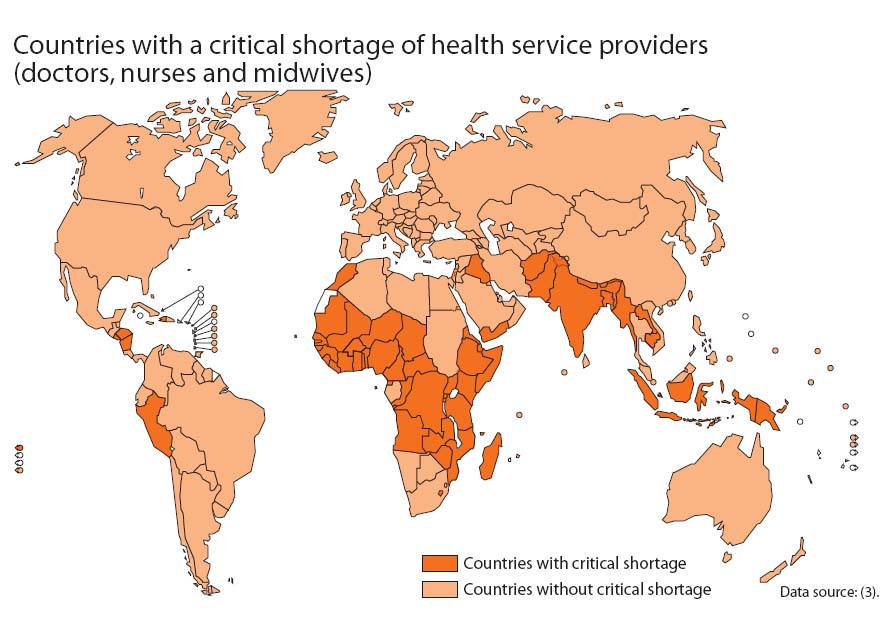
A couple of years ago the London School of Tropical Medicine and Hygiene piloted its famous Diploma in Tropical Medicine course in East Africa. Obviously it’s been a huge success, as not only do you get to learn about exciting medicine from a world leading institute, you get to do it in vivo, with unequalled access to local expertise and clinical cases. As one of the many hopefuls applying for this course in 2013, I was interested to note human resources for health as their choice of topic for discussion on the enrolment form.

Human resource for health (HRH) involves analysing the distribution and quantity of healthcare workers worldwide, treating them in a similar way to more traditional ‘resources’ such as coal, minerals, etc. This allows for powerful analysis of the data available, which in turn is used by policy makers and governments to make decisions about the number of healthcare workers they need to train and employ.

It is just such a topic where one might lead a wonderfully fulfilling life without being aware of its importance, until its implications are brought to bear on one’s health system. Almost universally, the statistics about HRH make for pretty grim reading. Did you know for instance that there is a worldwide shortage of health care professionals to the tune of about 4.3 million? Even worse, of the 57 countries deemed to have severe shortages of healthcare professionals, 36 are in Africa. One more shocking fact? Although Sub-Saharan Africa shoulders 24% of the world’s disease burden, it is home to only 3% of the world’s healthcare workers.

The reasons for this inequality include a lack of workers being trained, migration (the ‘brain drain’), anomalous data on HRH, and burden of disease. It’s a complex problem, and one that is gaining increasing recognition as being the next big barrier to improving healthcare in Africa. The development of the Millennium Development Goals has mobilised a lot of funding towards healthcare in Africa, but without the right people on the ground money alone cannot solve the problems.

We’ll be revisiting this topic on our trip, as well as reporting on any examples we encounter, and looking at the potential solutions to the HRH crisis.


(Image adapted from the WHO Health Report 2006)

A New Objective

According to the World Health Organization, just under 300,000 maternal deaths occur worldwide each year, with over half of them in Sub-Saharan Africa. Amongst the more major causes of mortality is eclamsia, a condition of unknown cause which can result in the death of both mother and foetus. Blood pressure monitoring in pregnancy helps to identify those at risk of eclampsia, and facilitate appropriate intervention. However, delivering a service that provides regular monitoring and intervention in Africa is currently a huge challenge.
With this in mind we are pleased to announce that we have agreed another major additional objective to our trip. We have been in communication with Kings College London regarding their CRADLE trial, which is an international research project supported by the Bill and Melinda Gates Foundation with the following objectives:
–  Improve the data that we have on maternal mortality across Sub-Saharan Africa
–  Pilot the use of a new compact, solar powered blood pressure monitor
–  Investigate the effect of the regular use of this monitor on the rates of maternal mortality in Sub-Saharan Africa
–  Allude to the cost effectiveness of establishing blood pressure monitoring services in Sub-Saharan Africa
We will work to introduce these devices to Ethiopia, and gather and analyse data from their use over the period of approximately a month. We are hugely excited to be a part of this project; we’ll keep you updated as we know more.

The Locum Phenomenon

A curious yet seemingly essential phenomenon in filling medical staffing rotas nationally is the existence of the locum doctor. ‘Locums’ are generally short term, (reasonably!) highly paid contracts, similar to supply work for teachers, or subcontracting for builders. A doctor is parachuted into a new team, often in a hospital where they have no previous experience, and potentially into a role where they have had minimal post-graduate experience. The roles filled by locums are often key to the functioning of a given team within a hospital (such as general medical, general surgical, and orthopaedic teams). Often a fairly hair-raising and exhausting experience, veteran locums become hardened to unfamiliar work environments, clapped out NHS on-site accommodation and loneliness (if working in new pastures for short times).

 These contracts are highly costly to NHS trusts, but I suppose are justified by the logic that ‘anyone is better than no-one’. Trusts cannot leave themselves open to criticism by leaving these key roles unfilled lest a patient come to harm from understaffing. However from the inside it often appears as though many of these holes in rotas are predictable – there must be a better way!

 One solution might be to adopt a similar system to the antipodes, where junior doctors are required to complete a ‘relief run’, a period of 3-4 months where they plug holes in rotas in a similar way to locums but are paid a salaried wage. I duck as I write this however, for this suggestion may bring slander and outrage from my colleagues who would consider this period to be of poor educational value.

 An arguably unnecessary waste of NHS money perhaps, but until a better system is devised, locum shifts will continue to plug the gaps in essential medical rotas throughout the UK. They are great for the three of us however, as back to back locum shifts are what we are depending upon to finance our expedition!

October Send-Off Bash

From time to time one of us will take a little breather from the self-induced chaos that is our day-to-day life and realise that time is in fact ticking on, and we are off on really rather a big and involved trip in the not-too-distant (in fact frighteningly all-too-soon) future. I’m writing this in just such a gulp of air that involves an evening off with a stubbornly uncreative brain, a handful of peppermint tea and an internet dongle that has far too much autonomy.

My task for the evening: inform you all of a wondrous event that we are heralding in October. Bass, Dan, Guy and I have been lucky enough to live together in Perranporth for the last year, which in its self has been an amazing experience. One of the best things about our year has been the warm friendship and membership of the local Cornish choir, The Perraners. We’ve shared many a great evening of laughter and song in Perranporth with these great people.

The Perraners sing at sunset on Perranporth Beach. (RWH)

We’ve organised this evening as an excuse to get old friends back together, sing our favourite songs, eat some good food, and raise as much money for charity as we can! Having set our departure date for the next day, we thought it would be an ideal send-off bash. Luckily we don’t have too far to go on Day 1 – a bleary-eyed drive to Somerset and Bass’ family home!

Allow me to furnish you with The Headlines:

–          A hearty sit-down meal with wonderful home-made food, courtesy of Seiners

–          A charity auction/raffle

–          Cornish songs with the Perraners

–          Other guests TBC

–          October 7th, probably 7pm!

–          Tickets £10 (meal included)

Please get in touch if you’re interested; cornwalltocapetown@gmail.com

Much love,

R, B & D

The Making of Mechanics?

So, we had proven that we could drive long distances, under the pressures of time and inclement weather. But that would only get us so far…

We found out exactly how far two days later.

The village of Perranporth can be quite a honey pot when the weather is beneficent, with the center being a hub of activity. So it was that in the height of the midday pasty rush, and with a mechanical clatter worthy of a Tom & Jerry cartoon, our car suddenly lost power. After a few sheepish minutes of tyre-kicking and bonnet-lifting, we found that the rear prop-shaft had shorn through, leaving the longer half flailing against the cars underbelly.

I would like to take a brief interlude at this point to discuss mechanical vocabulary. As we hope some Landrover enthusiasts will read this, we will not shirk on technical talk. However we cannot continue without reference to the enormous capacity that mechanics  holds for innuendo. We have no intention in following the success of Fifty Shades of Grey, nor do we want to write the script for ‘Carry on Africa’. We can only assume that the discipline needed to discuss sockets, rods, grub-nuts and grease nipples without a ribald smirk or bawdy nudge comes to a professional mechanic with years of training. We simply don’t have the time or the maturity.

So We were stranded in a beachside lay-by with little chance of recovery.

We were quick to analyse the situation:

Pros: this could have happened in the Scottish Borders when we had no breakdown cover.

Cons: We were causing what was a significant hold-up by Cornish standards with no hope of a quick fix.

It was at this point that we were to find that in a Land Rover, help is often near at hand. A few minutes later a friendly man in an old 90 drove by and offered assistance. He was able not only to tow us to safety but provide the part from one of his several Land Rovers.

We had our first repair job. We tackled the problem the only way men of our generation know how: a key-word search of Google. It seemed like a simple matter of unbolting the broken bit and bolting the new bit on. However we hadn’t realised that these parts had been bolted on with thick steel when we had been about six and left to rust fast in the Scottish highland. Dan spent the best part of a week on his back, locked in a duel with each stubborn and accustomed bolt. He eventually emerged, oily, eyes raw with rust, the mad grin of a man who has tunneled to freedom with a teaspoon on his sooty face, brandishing the broken part. Rusty nuts would be a problem that would continue to trouble us.

Rich chanced upon a chap called Dave, an ex-sapper who lived up near Exmoor and ran a casual bush mechanics course. Well-schooled in Land Rovers from a young age, he was a keen expert and seemed excited to have new vehicle, complete with new problems to solve. Over two weekends, we visited his eccentric converted church and work-barn arrangement and set about getting to grips with our machine.

A modern car is a magical automaton synapsed  with wires and computers that know better than you do. If angered in some way it will devise a fault only fixable with a laptop and part so specialist that there needs to be a company to make the tools, for a company to make the tools to make it (at a price necessarily high to keep all these companies afloat). At first this is how our Land Rover seemed. However after two rainy weekends and quite a lot of studying before and after, it all started to make sense. The whole process of how the timed cycles of a piston generate force, this force being handed from gear to gear to shaft to wheel began to lock together. We saw first hand as we removed each part, how the forces of explosions in quick unison are harnessed by a clever arrangement of oiled metal moving parts. We learned about breaking, cooling, suspension and exhaust; tools, jacks, oils, wheels and lubricants.

Dave’s style of teaching certainly nurtured the initiative essential for a bush mechanic (these days defined as a mechanic without Google). He would happily watch us discuss how best to gain access to the transmission or lever the tyre off a wheel. This cemented the procedure into our memory. As well as teaching the correct approach to repair and maintenance procedures, he encouraged the improvisation needed to fix a problem with limited resources. One crowning moment was fixing our recently busted differential lock. We stripped away the casing and used a parts manual to narrow down which part was broken. We meticulously removed each fitted lever and cog and found the culprit (a sheared grub screw if you must know). Of course taking things apart is easy; it is the putting back together that is the challenge. Our Landy is simple enough that, by and large, as long as long as you put it back as you found it, you haven’t made things worse. This of course is a simple theory with a frustratingly complex practice. On attempt number three, the Diff-lock lever slid firmly and smoothly in, to engage the engines full power, with manly roars of satisfaction all round.

We were on our way to becoming bush mechanics.