Aswan to Wadi Halfa: Half-a Tale of Two Cities

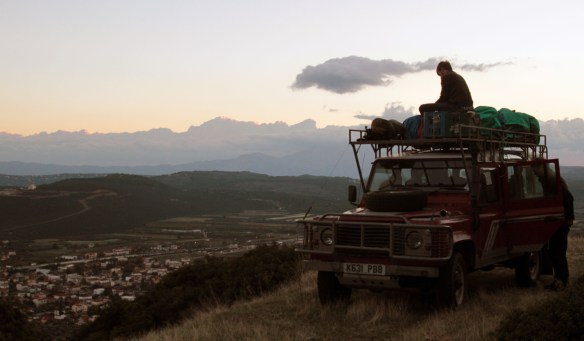
It transpires that Aswan is a tourist hotspot. We discovered this when we tried to buy a kofta roll and paid five times the going rate for it. People visit in order to cruise the Nile and visit the colossal tombs at Abu Simbel. We arrived however to catch the ferry to Sudan. For this reason Aswan is also a focus for African overlanders. We arrived in Adam’s home, an overlander’s campsite, hungry and exhausted as had become the norm. We unloaded our belongings into a mud brick hut and were then given the tour by Mohamed, a Nubian who had spent several years working in Cornwall of all places. In honesty we were reluctant to participate in said tour. It had been a long time since we had eaten and we were anxious to start cooking our late supper. Nonetheless we trailed courteously behind Mohamed as he cheerfully explored various huts and facilities. He led us through the kitchen, which was alive with activity. Six Nubian men were performing a complex food preparation waltz. Some rolled rice parcels; others stirred bubbling pots and shook sizzling pans. We surveyed enviously. We would not be eating for an hour at the soonest, even if we could manage to cook without getting tangled in the gears and limbs of this admirable grub machine.


Mohamed herded us into the communal area where a low table was laid for an enormous feast, he explained that they were celebrating the birth a of a baby boy to one of the men. The smiling father earnestly encouraged us to sit with them on the wicker mats and eat, in so doing he proffered a bowl of cabbage leaf domadas. Despite our grumbling stomachs Rich and I tried to politely decline. Our limp refusal was halfhearted however as we were starving and furthermore Bas already had a domada in his hand and two in his mouth. We sat.


The table was overflowing with dishes. Bowls of tahina, bean fuul and chili sauce, roasted chickens stuffed with risotto rice, curried sausage casserole and pitta breads. We ate until we could not move and then crumbled back onto plump cushions. We lounged there completely immobilized and reminisced about old England with Mohamed until, conquered by the warm cannonball of food in our bellies, we retired.


The next day was all business. We had been procrastinating and the time had come for some serious admin. We drained the rear differential and replaced the leaking gasket, changed the engine oil and filter, changed the fuel filter, washed the air filter, wired in the inverter, split charge relay and second battery. Not bad for a mornings work, we were getting better. In the afternoon we went on individual missions for supplies and food for the ferry. My job was a replacement camping gas canister as I had had trouble with this task in the past and was not willing to hand over the baton to anyone else.


I walked out onto the streets of Aswan and could not believe my luck; the first person I asked knew exactly where to find gas, as did the following six people. Strangely all of them brought me to the same tourist market selling the same Chinese-made sunglasses and plastic jewelry. In an effort to escape I crossed a railway bridge to the other side of Aswan. This was like walking into another town all together. All of a sudden tourism was a myth and I was in Egypt proper. I stepped off the overpass and was promptly mobbed, not by churlish tat retailers with a sense of entitlement but by boisterous livestock. Chickens, goats and turkeys waddled and skipped among my feet, grocers shouted their wares and prices. Butchers hacked cuts of meat from hanging hooks and fishmongers lustily slapped their slimy produce on slick steel trays.


I continued asking my question, and received an assortment of more honest, but still ultimately useless, answers. I wandered behind the stalls and came across a handful of aged souk vendors sitting on low plastic stools. They were talking and laughing volubly so they did not notice my presence for some time. At length, with the help of a small biro diagram on the back of a cabbage, I was able to make my request understood. I waited while the wise old merchants conferred. Minutes passed and I became restless to continue my search. Presently the man seated opposite me wearing a black turban and eyes shot with pink stood up in a hurry as if he had suddenly cracked the riddle. He began rifling through his many layers of smock and with a broad grin produced a gigantic spliff. The men lit up and continued their cheerful dialogue. This was getting me nowhere so I mumbled excuses and ambled shyly away. As I retreated, black turban yelled something to me in Arabic and pointed to the other side of road at a man on a motorbike. I approached the man who said to me in English, “you look for gas can, yes?” Dumbstruck, I glanced back at the merchants and then nodded agreement. He jerked his head at the pillion seat of his motorbike and I climbed on.


We bounced over speed bumps and zipped amongst market stalls, skillfully circumnavigating tuk tuks and articulated lorries. After a few minutes of winding lanes I was completely lost and I suddenly had a thought that brought me sharply back to previous memories of traveling. I dwelt on the fact that at that time I was completely at the mercy of this Egyptian stranger. He had only to take me to a group of his mates, somewhere out of town to rob me, or worse. This feeling of vulnerability is a daily concern when traveling alone but I had forgotten about it while traveling as a group. Thankfully, as is often the case, my concerns were not realized. My guide brought me to a small shop far out of town. We crept through a dark tortuous entrance to find a grisled man hunched, smoking a water pipe. My guide spoke to him and the old man pointed to a high shelf where I could see a gas bottle, bright and blue. My heart leapt. I asked to get it down but the old man shook his head. My translator explained that this was because the bottle was empty. Excellent thought I. Well that was a fun waste of time. Deflated I explained that this was not useful to me. My guide seemed more disappointed than me that he could not help, he brought me back to the souk.  I was so close but ultimately foiled again. Perhaps in Wadi Halfa we would get gas. *

DSCF2738

The ferry was a scrum. It was Christmas day and we were lead up the gangway by our perpetually soused fixer Mahmet. We followed as his momentous bulk swung neatly through the crowd tearing a path. We hurried so as not to be caught and lost in the sweating wall of bodies. On the bridge, a few notes in the Captain’s hand secured us a few square feet of deck to rest on. We lay in the sun, lazily burning and watching while the boat slowly filled. Multitudes passed into the hull during the course of the day, each dragging several times his body weight in luggage. The majority were Sudanese traders and their families. Their luggage was produce and electrical products bought in Egypt to sell in Sudan. Countless items were roughly tied or bagged, then hauled up to the deck. Perhaps the significant proportion of goods that are lost to the depths, as a result of absent-minded handling, is written off by the traders as acceptable losses. Indeed no one batted an eyelid when a man next to me turned to speak to a friend and let loose a rope carrying eight magimix blenders allowing them to fall 20 ft, smash apart on the concrete pier and then bob gently away on Lake Nasser.


The ferry was a sociable experience. The route from Egypt to Sudan runs weekly and was cancelled the week prior to our arrival. As a result it formed a bottleneck for all the travelers heading south. These consisted of two Swiss overlanders, two Croatian journalists, a Canadian family, an English cyclist and a couple of Germans. The last westerner we had seen was in Turkey so this glut was quite a novelty. Furthermore we had to drink any alcohol we had about us before arrival in Sudan where one receives 40 lashes for possession. A penalty we were, needless to say, keen to avoid.


We popped open dusty bottles of beer that had watched our progress from the roof of the Landie since Perranporth. The first drop of Betty Stoggs dragged us back to a Cornish beach and shanty singing on warm September nights. As the ferry pulled us through the still water to Sudan we sang old pirate songs and swigged our ales. The Captain only rarely interrupted our merriment by stepping from the bridge to make his prayers. At these points we would carefully conceal our beer and impose a brief intermission on our raucous shantying. Spirits were high among the traders as well, they were happy to be on their way home. All on the poop deck had a jolly time.


We are getting used to not being in on the joke

We are getting used to not being in on the joke

We sang and swapped stories long after the sun had set. We did not understand the naiveté of this behavior until it was time to bed down for the night. More judicious passengers had realised much earlier that a boatload of people occupies a lot more space lying down than they do standing up. As such, on scanning around for a few square feet to lay down our sleeping bags we found none. Rob, our English cyclist from Preston, had flash of an idea. Bag in hand; he darted off for the lifeboats. He strode surely through the marsh of shrouded bodies. In the gloom he aroused frequent sleepy protests when his waivering bare sole found purchase on an unsuspicious face or groin. Sadly Rob’s search was fruitless. Each lifeboat was a snoring can of Sudanese sardines. Rob shambled back disheartened, his feet carefully sparing his earlier victims in favour of a new path of faces and groins. Eventually, we each found a small corner of deck to curl up in and the snug sleeping conditions kept us warm for the few remaining hours before the sun.


To be continued…


* 8/1/13 – We still have not found gas.
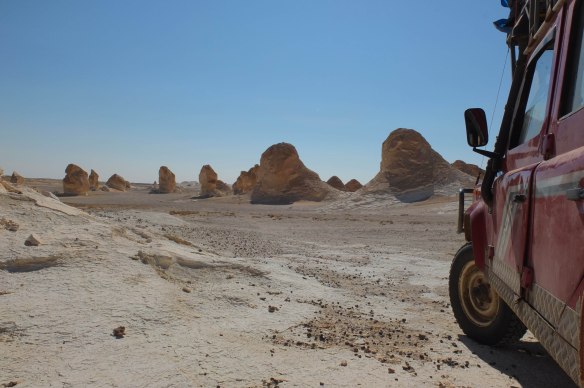
Been through the desert in a car with no name…

We decided to drive the Oasis road, looping for 800 miles west, away from the Nile, rejoining it at ancient Luxor. Diesel was a big problem. The country was virtually dry due to the conflict inhibiting trade. To avoid the day-long queues of lorries, one had to turn to the black market. Fortunately, Sam had a contact, Badri, a local Bedouin, in the oasis of Baharia, who would arrange for onward fuel. The fact that diesel was three times the price on the black market vexed us little as this brought it up to 33p a litre.

Before we left Cairo we were able to have lunch with Enrique, a Spanish journalist fresh from the pre-referendum interviews. The country was poised to vote on a new constitution. Essentially it would decide if the country’s laws would be based on the Holy Qur’an and whether the judiciary would be able to overrule the president. Divisions were running deep in a country fresh to democracy and there seemed no question of compromise. More organised and with the mosques as a platform, Morsi and the Muslim Brotherhood looked poised for a successful ‘yes’ vote.

Thus began our days driving the dot-to-dot of oases. We crossed the sharp border away from the dense, living Nile. We crossed over to where the only sign that anything lives, or has ever lived, is the shimmering asphalt. That evening we killed the engine to make camp. Our ears rang with silence.

The Western (Libyan) desert is impossibly dry but deep beneath lies a fossil sea, ‘the aquifer’. Water can be tapped where the land recedes below sea level. Today diesel-powered pumps provide ‘unlimited’ water for the networks of villages and farms in each basin. Nobody knows the origin or limits of this mysterious underground sea and the oasis people are not the only ones pumping. A thousand miles west in Libya, ‘Gadaffi’s Underground River’ pipes untold gallons away to the coastal settlements, on a much larger scale. It is no surprise that many believe the future wars of Africa, will be fought over water.

A night’s camp and a day’s drive on a good road brought us down into the flat basin of Baharia. Here we met Badri, friendly and serene, for a late lunch. Sure enough he had arranged for 100 litres of diesel. We filtered it into our car and jerry cans to remove the water, which is often added by Egypt’s ‘businessmen’, to bulk out the sale. This time, we found it to be of excellent quality. Pressing on, we made it out, over the lip of the depression and were once more alone to watch the sun set. That night’s camp was a particularly jovial one as we sat around a roaring fire under an appropriate crescent moon drinking Saqara lager and singing.

The next day we reached the White Desert, miles of wind-cut, blinding chalk. Stacks of rock had been preened by a titanic topagiarist into mushrooms, rabbits and other shapes that, were we all not so pure of thought, could be interpreted in a suggestive manner. We left the car and wandered like liliputians in a madman’s garden until the heat drove us back.

The White Desert

The White Desert

The Oasis of Farafra, where we headed next, is the remotest bead on the bracelet, perched on the edge of the Great Sand Sea. Here another friendly face awaited our arrival. Juan, a friend of my uncle, had moved from Spain a few years ago to set up a hotel on the peaceful frontier. The mud-brick hotel was not yet ready and the situation back in Cairo meant few people were passing through. We pulled up at the gateway and were warmly received.

The hotel was the last building before the great sea. We had lunch in a shady, blooming garden. Supply lines were unpredictable and Juan received most of his food freshly grown and local from the Bedouin. We talked about the easy, interdependent community he had been welcomed into, of water pumps and of the summer when everyone lives and works at night to avoid the deadly heat. Our voices were pure in the silence, the void behind us absorbing all sound. Beyond the tended garden we walked out, barefoot in the late afternoon sun. The Oasis seemed like a raft, temporarily granted life on a calm ocean, serenely bobbing near an unfathomable shelf.

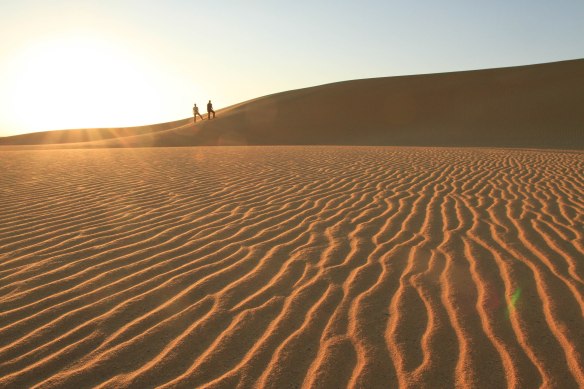
The Great Sand Sea

The Great Sand Sea

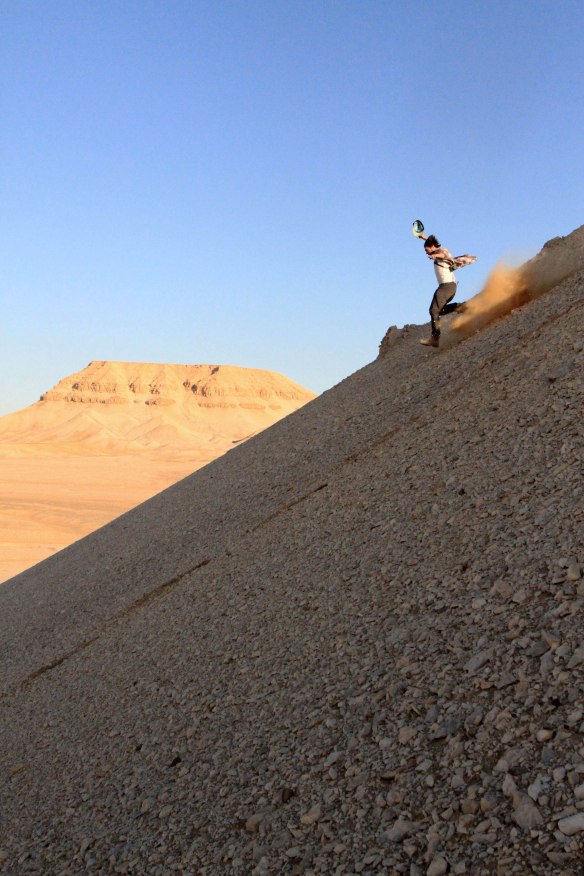
We spent a further two days in the desert, driving, climbing to vantage points and charging down the dunes. Other cars or people were rare enough to warrant comment whenever they occurred. We finished each other’s sentences, chuckled over long-running jokes and argued bitterly over which way north was or how best to divide the remaining jam. I feel sorry for the next people to travel with us.

Our struggle with the Egyptian institutions continued as we drove through overstaffed, isolated checkpoints. As early as the Old Kingdom, Egypt had developed a centrally organised system that could accurately forecast crop yields, co-ordinate labour and calculate taxation. In short, the Egyptians invented bureaucracy. The hundreds of lavish tombs of scribes with titles such as ‘overseer of the harvest’ or ‘commissioner of art’ implied that taking advantage of an official position was not a new concept. Even now an entire section of society still depends on checking, stamping and low-level backsheesh. This, coupled with the ‘Inshalla’ mentality (literally “if Allah wills it” but actually meaning anything from “possibly” to “yeah right”) means that everything in Egypt tends to take a long time.

Another two jerry cans of backstreet diesel brought us late one night into Luxor. We blinked, wide-eyed and dusty at the lights. Accustomed to the peace of the desert, we were overwhelmed by the milling street crowds in long robes and the stampeding traffic. We escaped into a hotel for a much needed shower.

Running away with it!

Running away with it!

Luxor is a whirling rush of living streets, merging under the great temples of the New Kingdom (relatively new, this cluster of dynasties is still over three thousand years old). A parade of markets and vendors vied for our custom as we walked to the centre. Here we were granted a glimpse of Ancient Egypt at its height. Again, there were almost no tourists. Before we left for Aswan, we crossed over the river to spend the day in the Valley of the Kings, once hidden, high in the escarpment. The tumbling necropolis and network of deep, painted tombs was preserved to the point of defying time completely.

The weekly ferry for Sudan was pressing us on. We left Luxor and headed on up the Nile for Aswan and the old Kingdom of Nubia.

Lower Egypt

In 1952, over the oasis town of Siwa, it rained for three hours. In this unprecedented deluge, the entire mud-brick town dissolved back into the desert. Surprised but unperturbed, the inhabitants, using the technique of their grandfathers, re-built the town as it stands today.

Egypt (38)c

Our stay in the super-city of Cairo was drawing to a close. This conurbation of old and current capitals from passing empires, sprawling across the populous delta, holds 20 million people. It is growing at around one million a year, consuming the fertile topsoil for bricks and covering over the farmland. The Nile, which has always defined Egypt’s fate is being driven harder, like an uncomplaining pack-mule.

The big, bleak picture aside, the inhabitants make Cairo as pleasant as it could be. Between the great flyovers and bridges, an easy-going attitude prevails over day-to-day life. This was quite surprising considering the great turmoil that was unfolding on the news. We were welcomed and included into the slow traipse of hawking, haggling, tea-drinking and sitting around. The continuous stock ‘civil disorder’ snapshots had been very effective and we were alone as travellers in a country that depends heavily on tourism. Dejected Nile cruise-boats moored up along the banks, Hotel staff sat, hopeful in bowties and waistcoats and the empty halls of Egyptian museum echoed with the sounds of protest outside.

For me Egypt proved bigger, poorer and heartier than the troubled new Arab-republic I had imagined. Of course, in areas such as the pyramids, we were seen only as a source of cash. We hit these gauntlets headlong, within a defensive bubble, closed to the touts’ cunning gambits. Away from these magnificent tourist traps however, we found the Egyptians had an incorrigible welcoming streak which the troubled times and the abandonment of outsiders had amplified. The lines between business and friendship were completely blurred and the uncertain mixture of hospitality and sales-ploy took a great deal of getting used to. However to remain closed and untrusting is to remain an outsider. Although our friends occasionally lead us into a perfume shop or offered us desert trips, local crafts or hash in convoluted adventures, the majority were happy to sit and share ideas. The one golden rule is not to trust any directions. The people we met were so genuinely keen to help that to admit they didn’t know the way was out of the question. Whilst looking for a hostel, we were confidently pointed in every direction around Cairo for two hours before returning to where we had parked to find the hotel by chance, next to the car.

One night, we found ourselves hopelessly lost amongst dust roads and block houses, searching for the pyramids of Saqara, where we naively hoped to camp. Whilst dithering around a locked gate we were picked up by Mohammed, on holiday to visit his family. He worked as a horse-boy in Sharm-el-Sheik, taking wealthy Russians riding around the dunes. We were tired and suspicious of his enthusiastic offer to take us in, but he persevered. It was the right decision to follow him. That night, after a meal with his family, we sat around a fire on top of a rocky mound of tombs. In the dark, the shadows of the Saqaran pyramids hunched to our South with the otherworldly suggestion of the great pyramids of Giza far to our North.  Six men in heavy robes and casually slung guns, guardians of the ancient site, approached us with foreboding. The leader, distinguished as such by the richest and curliest moustache, stepped forward to investigate. He was at ease by the local boy and after a discussion with the second most magnificent moustache, allowed his troop to join the camp. Our unlikely group sat in a circle far above the encroaching houses drinking tea, swapping cigarettes and comparing facial hair into the small hours.

Egypt (32)

The legacy of millennia, casually evident among the muddle, is all the more impressive considering how Egypt consumes the past. What the all-swallowing desert spared of the overlapping palaces, pillars and towering deities, was exposed to the population, creeping, and tearing like vines; inhabiting and borrowing from the mysterious rubble. Then came the iconoclasts, the chisels of jealous pharaohs and the purge of the new religions. Eventually however, the Christian plaster and Arabic paint peel and crack to reveal the sharp hieroglyphs. Fearful armies and even Napoleon’s cannon have yet failed to tear down the pyramids. Each new captor forces their fleeting mark and is assimilated into the great organic permanency of the Nile people.

In the pleasant suburb of Ma’adi we met a man who would open up the desert for us: Sam, a British ex-pat who among other things, drove a defender and wrote for Land Rover Owner International. As luck would have it, he was planning a weekend expedition into the Western Desert and needed a second vehicle. Among the proposed objectives, Sam proposed descending an escarpment, crossing the Gebel Guhannim dunes toward the al Faiyum Oasis. En route and driving out to the Whale Bone Valley, Sam had offered the Regimental Society of Great Britain to build a memorial cairn for the 1st demolition brigade (known as Popski’s private army after their Belgian commander), who had trained on the challenging terrain with the SAS before engaging Rommel. This plan was explained to us in front of a wall size aviator’s map over several beers. We tried to remain collected and disguise our excitement.

There are two borders that define the nation of Egypt: The political; unbending concepts far out beyond the horizon; and the actual; the distinct point where the narrow, Nile-fed band of living jade suddenly stops. From here you walk out a hundred paces onto a landscape where civilisation is impossible and sustained life a masterpiece of centuries. From here you could be in Libya, the Sudan or 100 miles from the Atlantic Ocean. You have already crossed the border to where the only distance that really matters is determined by your water and fuel supply.

Having departed Cairo at crack of dawn our convoy joined the clear desert road. Hours of flat gravel were interspersed with the occasional flame of an oil refinery. At a point where the map seemed blank of features, we turned off the road. This experience in itself was liberating; the sudden realisation that one is not confined to the road but can drive freely across the infinite landscape. We followed our lead vehicle for the morning, navigating over soft sand drifts and an increasingly rocky terrain. Our car buried itself in a sand drift to the axel and span hopelessly. Sam advised us to drop the tire pressures and we were amazed to watch our car float off over the sand. Eventually we reached the escarpment.

The patchy, clouds cast a net of silver shafts, scanning over the near and distant layers of rock. The land sunk down to the oasis depression twenty miles away and then chased off into the vanishing Sahara. We found a spot that surveyed this great vista to build the cairn. The two dusty Landrovers, perched on the edge and tiny under the sky, easily evoked the great era of desert exploration. We spared a moment to remember the men who had fought across this landscape, hostile and huge.  By midday our efforts were completed and it was time to descend.

The escarpment was formed of five flat strata with sheer slopes of sand and scree. To drop to the next level, we had to scout out a suitable slope before lining up and plunging down. The edge would disappear under the bonnet and for a lengthy second only the sky and the far horizon would fill the windscreen before the car would tilt and lurch forward. As long as the line was straight, the drifts of sand would slow the momentum. Then we would strafe along the face searching for another drop point.

Egypt (38)a

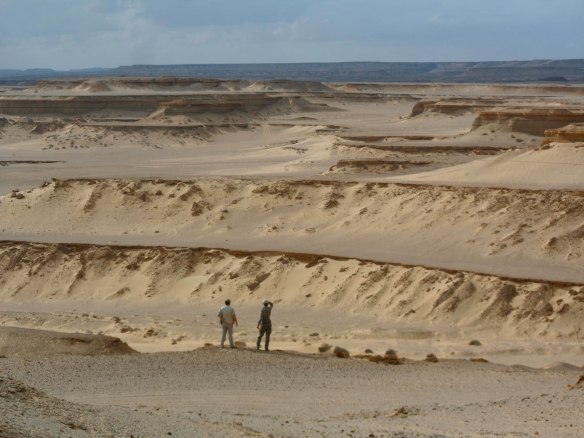
After descending the final level, we drove for hours across the dudes to a flat expanse covered in fossilised disks, smooth and glaring in the afternoon sun. Throughout the Cretaceous and Eocene eras, the Sahara was a great shallow sea, rich in life. We were headed for a valley where the soft chalk was gradually revealing its secrets. Hundreds of skeletons of ancient sharks, sea cows and pre-historic whales are meticulously brushed free by the winds. We walked the course of petrified mangroves, ladders of vertebra contorted into spirals, serrated jaws and hind legs on their ancestral road to becoming fins. The bones lay in piles on the sand or gradually emerged from the rock face. The sun set as we left the valley silent and still.

Egypt (41)

Merry Christmas

Merry Christmas everyone!

You can find our Christmas video here: http://www.youtube.com/watch?v=a56bHM4hfMM&list=HL1356340210&feature=mh_lolz

Yesterday we manoeuvred our car onto the Aswan ferry barge, at great cost to our nerves and some cost to nearby freight products that were crushed and mangled in the process of clambering onto the tiny area of roof space allocated for our car. An ordeal I think every African overlander must be familiar with. It was with a fair amount of trepidation that we allowed ourselves to be say goodbye to the Landie for the first time, trusting that it would arrive at the other end of lake Nasser for us to collect in a few days.

We will be taking the passenger ferry into Sudan on Christmas day. Indeed a wonderful Christmas day it will be, spent huddled in sleeping bags and coats on the deck of the ferryboat attempting to conserve warmth and the meager food supplies that we had the foresight to pack. There are of course less bitter ways to spend Christmas than cold and hungry on a ferry but I can’t think of any at the moment.

Well, that is probably enough from the misery violin. Consequently we will be having the back-up Christmas to end all understudy Christmasses on the 27th Dec. By this time we will have arrived in the warmth of the Sudanese desert. We have joined forces with a pair of Swiss overlanders, with whom we have made big plans for Christmas dinner in the desert. We will build some sort of clay oven in which to roast a turkey (ambitious perhaps?), cook roasties in the embers of our fire, and Bas has big plans for making a Sudanese version of bread sauce. Most importantly we have coloured party hats in which to drink whatever beer we can find in Sudan. It is going to be quite the shindig.

If anyone would like to call us on (Deferred) Christmas Day 27th Dec we will hopefully be available on  (002) 01026445667

This number will likely be updated with a Sudanese one in the next couple of days so check here for the new one.

Merry Christmas and a Happy New Year to all our friends, family and readers.

Tea on Turbulent Tahrir

Cairo – 10,472 miles

The taste of freedom was fresh on our palates as we approached Cairo, and our excitement offset any apprehension we should have felt on approaching this hotbed of political strife. The world’s media was honed in on this city as the crowds expressed their discontent with the current government. The Egyptian people famously ousted their leader Mubarak in 2011, leaving the military to organise the country’s first ever democratic elections. President Morsi led the Islamic Brotherhood to a narrow victory in June 2012, and since then has been at the helm steering, rather clumsily towards what some fear and some hope may become an Islamist state. On the 22nd of November he issued a declaration which stated that his decisions were “final and unchallengeable by any individual or body until a new constitution has been ratified and a new parliament has been elected”. To many, this harked of a second Mubarak, and a step back towards the temporary state of emergency in 1967 which lasted for over 40 years. Morsi put forwards a new draft of the constitution on the 29th November which many Liberals and Coptic Christians felt encroached upon freedom of speech, women’s rights, and the recent democratic gains made by the country. Tempers boiled over in a spate of violent clashed between the Brotherhood’s supporters and anti Morsi groups, culminating in 5 alleged deaths outside the Presidential Palace on 5th December. Morsi eventually caved to public pressure and retracted his 22nd of November declaration. He has insisted however that the new constitution be taken to referendum, despite objections by the majority of opposition parties. Violent protests continued centered around the now famous Tahrir Square, even as the media drew comparisons with Syria’s downward spiral into civil war.

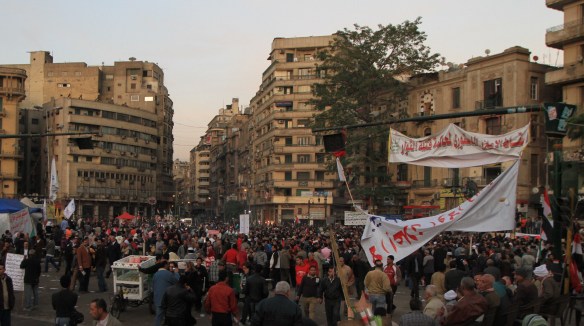
Heartfelt demonstrations on Tahrir (Photo: RWH)

Heartfelt demonstrations on Tahrir (Photo: RWH)

It was in the week leading up to the referendum that we approached Cairo. We were not afforded the luxury of time to worry, as we were fully occupied with navigation and personal safety. The drive into Cairo had us harking back to our childhood Mario Cart days, desperately trying to avoid the next banana skin. We were on a Gothen City-esque motorway flyover which elevated us from the cramped and grimy streets below. Our route had us dodging past incomplete and occasionally non-existent sets of car lights in a navigational no-man’s-land somewhere between the Michelin’s ‘Map of Arabia and North East Africa’ and Lonely Planet’s tiny map of ‘Central Cairo’.

We swung our way through the serpentine streets past shisha stands, chai stalls, and army tanks. We eventually found a cheap hostel populated by a rather perplexed receptionist, whose ample eyebrows shot up at the sight of three road worn Brits stumbling through the door into an otherwise empty building. We rather anxiously left our beloved Land Rover parked on the street overnight. Lying on our beds, exhausted from the drive, we contemplated our location. Barely four hundred yards from Tarhir Square, we could hear the sound of a huge crowd in the distance. The roars were occasionally punctuated with more organised chanting, and the distinctive sound of rubber bullets being fired.

Other than blatant tourism, the purpose of our visit to Cairo was to try and persuade the great nation of Sudan to furnish us with visas. Studying the map the next morning we discovered that although a short walk away, the embassy was inevitably the other side of Tahrir Square.

Being fully subscribed to the concept of ‘as the crow flies’, and afflicted as we were with a triple dose of young man’s curiosity, we set off with our wits in close proximity towards the square. We passed some respectable barriers comprised of a veritable smorgasbord of barbed wire, razor wire and other sharp objects. Massive concrete cubes effectively blocked access to the square from most streets. Fifteen feet high and two score wide, they provided a blank canvas that was quickly utilised by political street artists. Tie-wearing workers and would-be revolutionaries queued together, waiting to squeeze through tiny gaps between the roadblocks and street wall. Suited businessmen scurried to and fro, picking their way between burnt out cars and tut-tutting at the dust on their shoes from hundreds of trampled sand bags. Self appointed guards overlooked the proceedings sporting bandannas emblazoned with anti government slogans. One of them enthusiastically showed us a flail he had made from razor wire and a length of metal piping, the handle of which doubled up as a sort of lethal potato gun. Despite looking not a day older than eleven, he was a serious young man.

An anti-Morsi protester guards the entrance to Tahrir Square (Photo: DN)

An anti-Morsi protester guards the entrance to Tahrir Square (Photo: DN)

When we eventually made the square we found to our surprise that it hadn’t been consumed in some post apocalyptic battle that our imaginations and the media reports had constructed. There were hundreds of people gathered, their numbers occasionally swollen by marches arriving in the square. They were loudly and passionately protesting, but they were peaceful. In between the crescendos, an atmosphere quite unexpected revealed its self. Street vendors had sprung up everywhere. Whiffs of sweet potato, roasted chestnuts, and falafel mingled with the more acrid smell of street bangers and burning rubbish. Chai stands squeezed in between the crowds. Hawkers flogged masks, whistles, flags and balaclavas in a rather dubious display of free market economy. Men perched outside graffiti covered tents smoking shisha and putting the world to rights. These were touching glimpses of everyday life.

We felt exposed but not unsafe. We were the only non-Egyptians evident, other than a few film crews perched high in buildings overlooking the square, or scurrying to and fro from the ample comfort of the nearby Hilton. As such we were frequently approached, and spent an interesting morning sharing tea and exploring differing opinions. Although these people were in the Anti Morsi camp, their common enemy had very much united them, and they expressed a broad range of political preference. Away from the square we encounter fiery youths convinced that the occupants of Tahrir square are all remnants of the Murbarak era, intent on keeping their positions.

A growing proportion of people seem now more concerned with the freefalling economy than in political rivalries. Overwhelmingly, the response to us has been one of sincere and enthusiastic welcome and a concern about the Egyptian image abroad. We were continually hailed with cries of ‘Welcome to Egypt’. We have been made to promise that despite the political turmoil, we must go home and spread the word that Egypt remains safe and welcoming to the outside world. For a country so dependent on tourism this is of little surprise. However, Egyptians are ubiquitously proud of their ancient nation and are appalled to hear that they are seen as dangerous to outsiders. This is one thing a nation, increasingly divided and uncompromising, still has in common.

To the Egyptian people, democracy was for many years an elusive bastion of hope that would solve all problems. The reality has sadly proved much more tumultuous. Although the days of overt corruption and fearful secret police are gone, the country is still a long way off representative political stability. Referendum queues several thousand long and ongoing protests prove that dissatisfaction is still rife.

Whatever the outcome of the referendum, we hope that the Egyptians can maintain a stable democratic state from here on in. Political consistency will reassure foreign investors as well as the international community and the IMF. Peace will flood their ancient monuments – currently deserted – with tourists once more, perhaps breathing life back into their floundering economy. We will watch the referendum results tomorrow with interest as we prepare to depart for the Sudan.

Any Port in a Storm

As we pulled our mud-caked vehicle alongside the twilight outline of the Flintstone’s Cave hostel in Goreme, Cappadocia we were greeted by welcoming staff and a few friendly Erasmus students.

“Looks like you’ve had fun, what have you been up to?” one enquired.

It would be a few days before the obscure images of the past 24 hours had cleared from our eyes enough to answer that question.

Millions of years ago in Cappadocia, a volcanic eruption or two left this desert region strewn with thousands of slabs of igneous rock. Subsequently the sandstone beneath has been eroded by wind and rain creating a dramatic landscape. Long serpentine gullies sweep around basalt capped golden towers. Lofty plateaus frame a striking scene that is littered with ancient dwellings cut directly into the stone by Troglodyte tribes first and Romans after them. In the warm wind we explored the hills and valleys of this fairytale land. Christian imagery remains intact on the walls of Byzantine churches cut from the soaring towers. Thousands of Christians evaded Roman (and later Turkish) persecution here in vast underground cities. The centurion tasked with flushing out the Christians from these five story bunkers would have had to evade traps such as giant rolling rocks and fallingspears. We spent hours exploring tunnels and chambers, playing out scenes from Indiana Jones and generally larking about.

We left Cappadocia wanting to stay longer but our ferry from South East Turkey was imminent. We roared through the hills east of Iskenderun passing tiny sepia villages, unreal in the glow of scant halogen lamps. We smashed the delicate silence of each town into clattering shards, barking and yelping in our wake. As we awaited unpopulated countryside in which to camp Bas stirred from reflection, “how far do you think we are from the Syrian border?” Somehow it at not occurred to us until that point that, as we flashed through the hills, we were fast encroaching on the disputed Turkish-Syrian border. The mood in the car sharpened and the quest for a camp received new urgency.

Eventually we found our way to the top of a bare hill under gathering clouds. We decided that while it was perhaps unwise to park on a hill in an electrical storm pressing further and bumping into Syrian revolutionaries, the Syrian Army or being mistaken by the Turkish army for either of the above was less appealing. That night our dreams were troubled by phantom conflicts between Turkey and Syria played out in the crack and boom of the storm.

We awoke at dawn to a tap tap on the window and the face of a Turkish farmer peering in. The hilltop on which we had narrowly escaped electrocution and an international incident was revealed in the light of day to be an enormous field of parsley. Like surly adolescents we tramped out of the car to receive our reprimand from an appropriately furious farmer. This did not unfold. In fact the farmer seemed heartily amused by the novelty of finding a Land Rover and three bewildered tourists lost in his parsley. After much awkward laughter, manly backslapping and handshaking we were allowed on our way with a generous gift from our host.

We arrived at the port of Iskenderun by 9 o’clock. After a quick breakfast of parsley sandwiches we registered and parked to await our passage to Africa, the Nisos Rodos. We were to depart at midday. By midnight we had started uploading, things were already starting to feel a bit more like Africa.

After a pleasant 24 hours aboard we were downloaded to Port Said, Egypt. Muted by excitement we took our first breaths of African air as the shadow of our car rolled off the ferry. Our tiny vehicle was lost in a mechanized jungle looming black around us. Monstrous grabbers, lifters and haulers were cut out in monochrome by our stark spotlights. Men with uniforms shuffled out of the gloom, we were not going anywhere until morning. They lead us to a locked compound where we were left for the night.

We cast about. Our new home consisted of a large rectangle marked out by razor wire. The ground was made up of years of compacted grime and leaked lubricants resulting in a nonspecific sticky filth. The compound was inhabited only by a handful of lorry drivers sleeping in their cabs. In the far corner was a single dilapidated toilet cubicle. Inside, a steel showerhead hung from the cracked concrete wall over a squat toilet that could have equally been the drain in an abattoir.

There are none as optimistic as the desperate. We looked at each other, “It’s just one night…it will be fine”. Ravenous, we set about making some food. As I chopped the parsley I watched a skeletal cat sizing up a rodent across the compound. Little red eyes glared back at the predator with unsettling hostility. Gripped by this tiny war I almost didn’t notice the hunched figure that stepped silently from shadows behind. As the outline of a man walked slowly towards our car Rich put his hand on my shoulder and I turned to see a pair of sallow eyes my window. Startled, I locked the door. Several more tenebrous shapes gathered around and began exploring our car with there pallid fingers. Growing numbers gave the spectres confidence and they started speaking to us. “What you doing here, my friend?” choked forth the first. “Nisos Rodos” Bas managed and was met with a chorus of whispered echoes. The first croaked again, “you need anything, my friend?” ruthlessly dragging on the words, “you wan’ beercig’retteshashish?”

“We don’t need anything thank you” Rich stated firmly. The potbellied leader pressed his cracked lips then smiled. “We come back tomorrow, maybe you need something tomorrow” the misshapen bodies slowly melted away. We went to sleep uneasy.

DSCF2521The next day we were up early, keen to sort our paperwork and escape this dreadful oubliette without any delay. Guided by our excellent translator/fixer, Mahmut, Rich made his way through 11 offices. Each office housed a slightly fatter man in a slightly sweatier shirt than the last. Rich financed progressively bigger bribes and in return inky stamps endorsed certificates proving all manner of things. Nothing inspires confidence like a large illegible rubber stamp. A bureaucratic tradition left over from the time of Empire, perhaps. All was developing well until one such clammy colossus clawed in his nose and, when satisfied with his findings, shot the same chubby digit at an assistant dispatching him to check our chassis number.

This was a catastrophe we had been hoping to avoid. Our chassis number has been previously galvanized over leaving us with no proof that our car is the same as the vehicle that our registration document discusses and not a stolen one. Luckily this problem was managed in a distinctly Egyptian way. Mahmut phoned his friend Mohammed who soon arrived and knocked the chassis number in with a chisel. Despite Mohammed’s skilled workmanship we held reservations about our being able to convince the border guards of the legitimacy of our forged chassis number on account of it’s being written in Arabic lettering.

These delays resulted in two more nights spent in purgatory. The long hours were passed predominantly trying not to touch anything and periodically batting away probing interest from the vermin and the pushers. On the morning of the fourth day we tried the gate. Mahmut conversed with the officer while we sat in our idling vehicle. The guard surveyed us over the mountain of forms, stamped in triplicate, skillfully devouring salted sunflower seeds as he did so, spitting a cloud of chaff after each one. He ambled lazily over and asked to see the chassis number. Rich mumbled something and pointed. The officer peered into the darkness under our wheel arch. He peered for too long, something was wrong. Mahmut was perspiring. Suddenly he darted around the car and, concealed by his body, mashed a wad of notes into an expectant hand. Stony faced, the officer completed his checks and walked back to his office in silence. In the dense heat we waited.  Minutes ticked past and nobody spoke. The barrier creaked and lifted; we held our breath unwilling to leave without confirmation of success. Mahmut flicked his hand impatiently and we crept out onto the road. Free. We gathered speed on the road to Cairo and began to celebrate. We jigged about boisterously in our seats and all the tension poured out to the tune of “Free falling” by Tom Petty. We were out, and with a full tank of diesel for a tenner we were on the road to Cairo.

The Struggle Back to Square One

I am squinting into the midday sun, clinging to the side railings of our Landrover. Crystallized salt burns in the criss-cross cuts in my hands and my eyes no longer focus with exhaustion  I am caked in drying clay that hinders all movement and dexterity  Our car is tilting to roughly thirty five degrees, the maximum point, beyond which it will roll. We have been dragged twenty metres, sliding laterally across an embankment by a tow truck. Despite the contributions of our supposed rescuer, our position is more perilous then ever. The body of our car lurches off the rear left suspension, front right wheel deeply embedded in the sucking clay. In fact all the wheels are axle deep in the cursed mud. If my hands tire and I slip off the railing it may mark the tipping point.

This is the second of the three abysmal low points of our journey so far. They all happened within 24 hours of each other. This is our account. We had spent many hours planning for crime, mechanical failures and natural disasters and but overlooked arguably the greatest threat to our adventure: Ourselves.

Rural Turkey

Rural Turkey

We had left Istanbul as a trio. Having recently been seven, the car seemed quiet and strangely empty. Spirits were high however: We had our ferry tickets to Africa and eight days to enjoy the rest of Turkey. The weather forecast for the central plateau predicted sunny days of 10 degrees with clear nights of -1. Up on the high bridge, in slow traffic, we crossed the obsidian Bosporus into Asia minor. The lights from both sides of the city merged and scattered in the cold water beneath. Istanbul is huge beyond understanding; over eighteen million people sprawling across two continents.

Two hours later we were still among the high-rise suburbs, navigating our vessel through five lanes of undisciplined and unscrupulous competition. Driving in Istanbul is by no means for the faint-hearted. “Lanes” is a word far more generous then the system deserves. Fortunately some belligerent driving from the helm of our hulking, bull barred vehicle* meant we were usually left a wide berth.

Out in the countryside we found a late night roadside diner that not only sold good, hot food but also long-johns, we stripped in the car park and donned layers more fitting for the coming cold. We then completely unpacked and re-packed the car to the inevitable large audience (we are becoming used a life of constant observation and performance). The proprietor, who must have warmed to this industrious farce offered us a wooden pallet. I doubt we would have survived the following nights without the long-johns and the pallet to use as firewood.

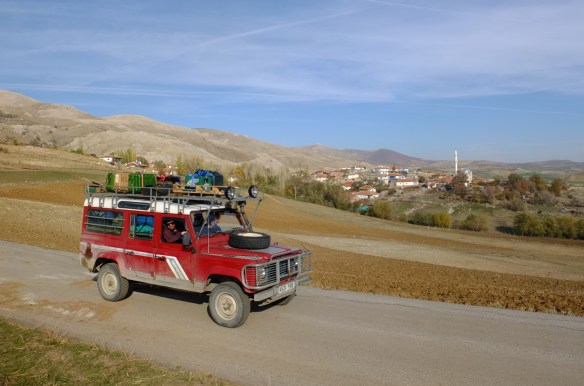
Under the midnight moon, we turned off and vanished into the hills. We slept on the platforms inside the car, in a forested hill, underneath radio masts. It took two sleeping bags and fleeces each, to keep out the cold until dawn. The next morning we drove on through the Anatolian plateau of central Turkey. The landscape changed from pine forest into sandy red scrubland. Minarets marked out villages embedded between hill and escarpment. We could now say that, beyond rational doubt, this was no longer England.

Due to a ‘misunderstanding’ with the automated toll barriers we were now unable/not allowed to use the Turkish motorways. However the old road was empty and just as fast when your top speed is sixty. The day drew to a close in the hills to the east of the city. We wound our way through villages where tired, low beamed houses bow under the weight of their tiles and the old men sit and watch. From a distance the whispering grass was interrupted by the roar of our engine and people who went to bed with the sun were brought out of slumber as their baying dogs chased a roaring, diesel monster from their village.

The frigid hills were now dressed sparse with rocky grassland. At one town we found lights in a tea-house and sent Dan to ask for directions. Rich and I neglected to remind him he still wore a head torch and a novelty Fez. After he had marched back, brow furrowed with embarrassment to return his costume, the villagers provided us with a hand-drawn map that showed where we were (which we knew) and where we wanted to go (which we also knew) connected by a straight line. We opted to continue using our own map and pressed on.

The full moon illuminated a winding shepherds’ track up into the hills. Our car scrambled up the dirt until we reached a rounded summit. We cut the engine to ringing silence and turned our headlights off to reveal that it was not night, nor day but timeless in a still and monochrome plane, rolling out to distant horizons. We climbed out of our capsule.

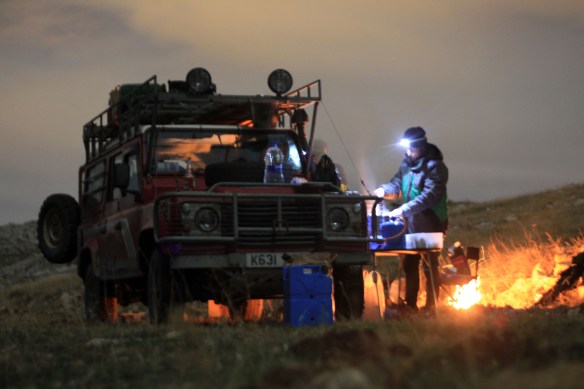
The Chef at Work

The Chef at Work

Bubbles and swirls of jet black twist through the perfect pure-white crust around our wheels. We’re sinking. I jump down off the bonnet into half a foot of clear salt water. Dan’s face is still cheerful. He has just asked me if I want to drive. I garble my realisation, profanities filling every available space. Keep driving. Keep driving. He understands instantly from my blood-drained face and jumps in the car. The engine roars, four wheels fly into a mad spin, the inky blackness spreads out further across what before was a mirror. The car sinks further as Turks yell and gesture fıfty metres away on the shore…

We rose with dawn to see a great swathe of Turkey beneath us, layered horizons fading into the haze. An eagle had began its days work. Its screech and the distant goat bells were the only feature in an expanse of silence. We made breakfast and congratulated ourselves on yet another excellent camp. This hubris proved too much for the fates to leave unpunished…

As we begun our daily inspection, disaster struck. Since a lubricant change in Greece, our rear differential had started slowly dripping oil. Lying on the dusty track I undid the inspection plug, checked the level, which was fine, re-tightened the plug with our breaker bar. I became worried when, after continued turning the plug was still loose in its thread. Confident in the knowledge that the piece fitted, I decided to give one further turn. As I eased the final turn there was a horrifying click and the plug slipped through the cast iron casing into the Diff.

I knew this was bad. A loose component among the complex gearing would blow the differential unit as soon as we tried to drive it, rendering our car immobile. I waited a moment before gathering the courage to inform the group. The load shared, we analysed the problem: Any attempts to move would destroy the drive chain to our rear wheels. The only way we could move would be to remove the half shafts (wheels), drive shaft and limp on to Ankara for help (at great expense and expertise. We needed to get that plug out. Our parts manual revealed a removable inspection panel, hidden on our car by the rust. If we could break the ten ancient and accustomed bolts, drain the lubricant and free the panel then we would be able to move off the mountain.

We took our turns lying flat on our backs with a wrench, heaving the stubborn bolt-heads. Each person would expend their energy and retire blinking out the dirt and rust to allow a fresh attempt. Silently, the doubt grew as to whether the panel was movable at all under the amorphous crust. The bolts were moving however and one by one, with the patience of those with no alternative, the ten holes we had pushed into cardboard to house the bolts were filled.

The three of us lay flat carefully inspected the casing, caressing the seam. We then struck it with a lump hammer. The panel split off like a flake of desert rock. Inside the oiled mechanics we revealed. Sitting among the gears was our culprit. We designed a new gasket from the card cover of our now obsolete Europe road map and began to put everything back together. It was afternoon, on a day which we had needed to put a solid eight hours driving in, when we eventually trundled off the mountain. However we drove a working car. Never had it felt so good to be back to square one.

The next destination on our long map was the salt lake of Tuz Golu. We made excellent time and our spirits rose and we held steady on the long, straight road. Our arrival at the lake was announced by the disappearance of the visible horizon. All we could see was the pink sky and the setting sun in double. Giddy and disorientated we steered our car toward the first possible slipway. We scouted the path down onto the perfectly smooth salt flat and were anxious about what we found. There was a moat of boggy clay about twenty metres wide separating us from the salt, that underfoot, felt like asphalt. The shimmering mirages beckoned, we threw our caution to the breeze. The last thing Dan said as he gathered the revs was,

“Are we all on board with this?”

The last thing I said was,

“Just hit it really fast.”

We gouged about twelve metres of axle-deep trenches before our momentum ceased and the wheels span us down to rest our chassis evenly on its earthy bed.

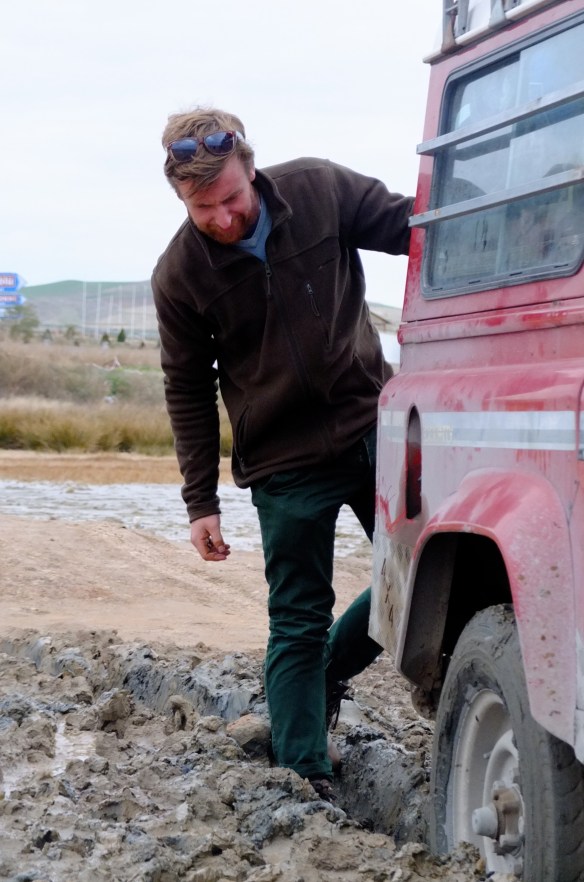
Thus began our great struggle. Looking back at the first hours, I realise how much we learnt about getting a car unstuck. Whilst there was still some light to work by, we tenuously picked our way through the salty mud, trying not to get our trousers muddy, gathering and placing rocks behind each wheel. I don’t think we realised how severe our situation was. The strange clay was the consistency of plasticine and stuck in great cakes to everything. A brick dropped into the sharp-scented bog needed a great heave to release it from the suction. Each thrust of the shovel strained our backs before the ground gave up its load with a reluctant, inward belch. The all-terrain tyres were slicked smooth and oily.

Stuck Again!

Stuck Again!

It took us an hour to discover that the rubble we were filling the tracks with was only hindering the tiny progress we had made back to Terra Firma by chocking the wheels. By now were caked in the mud, our hands fat and slippery on the shovel handle.  At this point we employed our sand ladders and wood planks. With continued digging and pushing under head torches we gradually clawed our way back to within a few feet of the slipway. Always, there would be one troublesome wheel spinning away our power *2.

The narrow earth slipway entered the mire at an angle to the car. We knew that we had to turn the car, in the next big push to hit the safe ground for on the other side was a deeper and soggier expanse to envelope us if we overshot. Sand ladders in position, Dan, who had remained the driver throughout engaged the wheels with measured throttle. The wheels caught and we hauled ourselves from our binding. Things happened quickly then. The momentum continued, the downhill wheels span and the bank collapsed. Tired beyond emotion we watched as we smeared a track down into the other side.

We could only press on. Dan, the least muddy, walked off towards civilization for food to raise spirits. In a nearby service station, the occupants gasped as a muddy, bearded man, wrapped in a blanket and a furry hat strode toward the bread rolls. With angry shouts the drove the vagabond out. It took a lot of explaining and convincing before he was allowed to buy food. With increased skill but empty energy reserves we continued edging our way across to mud-flat.

It was around midnight when I was roused from a world of digging by strange men shining torches in my eyes. We dropped our shovels to see Dan, standing behind three uniformed men with sub-machine guns. Dan had managed not only to source food but to persuade the reluctant police chief of a nearby town to come and help.

The car was rigged up with cable as our attempts to help were sidelined. We watched as their truck screamed and the cable tightened. One back wheel came over the slipway’s edge. They hit full power and our two ton red box lurched sideways, front wheels spinning huge ditches in the bog. Unperturbed, they dragged us in this awkward position for twenty meters before their tow-bar snapped. We were now leaning, stuck with one wheel high up on the slipway’s side and the others deep in mud. Our position was worse than ever as the police, shuffling and looking at their feet, muttered apologies and left. Totally drained we gave up and pitched camp. That night, the world span with fatigue. I dreamed that I was sinking in a swamp, being enclosed in the moist ground.

We were awoken by the sun and climbed out to be reminded that we had chosen a beautiful place to get stuck. The lake was shimmered the morning light. We had breakfast and got back to work. Rich was able to fix our previously broken high lift jack as I dug a deep pit for the hand winch to anchor. It was nearing midday when Dan arrived with a confident looking man and, more importantly, a tow truck.

Again, without any heed to our advice or help they pressed on rigging up the car. Again the car was dragged sideways as the angle reached tipping point. We started to hang off the side as it began to look critical. The driver’s response was only to rev harder. Furious and desperate, we shouted him to stop and think. He looked upset but stopped, studied the situation then sulkily re-rigged at a more favourable angle.

With four people hanging off the side, the car gave a final lurch, teetered on the brink and then began to slowly tilt back towards the flat as a second wheel cleared the edge. We were free.

After we had washed in the salt-saturated lake, we then had an important discussion. We had located a clay free route down to the water’s edge. So far, we had been defeated by this lake. Rich was reluctant. We had no food, no money and no energy were we to get stuck again. However,  there was no mud to be found. We decided to go for it, with Dan still at the wheel. We edged down to the lake and into the water, the ground was firm beneath us as we gained confidence slicing through the shallow water.

It was only when we stopped, far out from the coast did I spot our deepening tracks and it dawned on me that we had cracked the thin layer of salt and were sinking. It was too late however. The first flurry of activity ended with four wheels pressed through the sharp edges of four black holes. The soft clay beneath the crust, like the chocolate of a melted smartie, wasn’t holding our weight and we continued to sink. There was no towing from this far out. Dan, on the brink of despair whispered apologies to Rich. This despair only lasted a long moment.

With any badly stuck car, one’s chances of getting out tend to decrease with every attempt of escape. We had the added problem of what was essentially, quicksand. If we had any chance at all, we had to get it right first time. Had we not gathered the experience we had during catastrophe number two, I doubt we would managed. We would have had to salvage what we could and the dark silhouette of our wrecked car would have become a tourist attraction.

I scrambled up onto the roof and handed the newly-repaired high-lift jack down to Rich, who was able to lift each wheel out of its hole high enough to be filled with a sand ladder or a wooden plank. Everything now rested with Dan.

“Showtime mate,” said Rich as our driver gingerly climbed behind the wheel.

All I remember of the next few minutes was pushing desperately whilst I was sprayed with brine. The wheels span, caught, span and caught. At full-throttle our car lifted out of the abyss like an angered beast and jumped forward. It smashed fresh holes in the salt with a splash but the momentum carried it through. Then I was standing by Rich. Dan did not take his foot off the accelerator until he was on solid concrete. When we eventually caught up with him, we had to prize his white knuckles off the steering wheel.

We silently packed up and drove off on solid tarmac to Cappadocia.

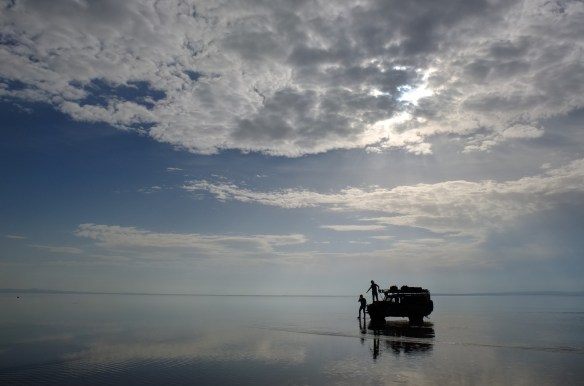
Salt Lake Serenity

Salt Lake Serenity

* 1. I imagine that, to the original designers of the Defender, the concept of ‘crumple zones’ was as inconcevable as the internet or a smoking ban in pubs

*2. For those not familiar with the world of off-roading, drive (power) is like electrical charge and follows the least resistance, so a wheel spinning takes all the drive out of a car. ‘Differential lock’ partially solves this but power still escapes if two wheels are spinning.

Istanbul, Street Dancing and Otoparking

We drove from the Turkish border to Tekirdag, a slightly grisly port town on the south coast. We arrived late and went in search of food. In a café at one o’clock in the morning we met Tayfur. Tayfur is a French language student studying in Tekirdag who very kindly offered to accommodate all six of us on the floor of his shared flat for the night. His housemates were a little surprised when he brought six bedraggled foreigners back having only gone out for soup.  In the morning washed and fed we embarked on the two-hour hop to Istanbul. We arrived six hours later and collapsed into a small hotel in the Old Town after a smog-choked traffic marathon through Istanbul’s outer sprawl.

The following day we walked the streets and lunched on Kokorec, a delicious spit-roasted kebab of sheep intestine seasoned with chili and oregano. We enjoyed aromatic Turkish coffee and munched endlessly on Turkish delight. As we gawped at our surroundings through dust-speckled sunshine, I was struck by a palpable appreciation of the fantastic age of the city. 2,600 years ago the Romans called it Byzantium and made it the capital of an Empire that spanned most of the known world. It has been a bustling, important metropolis for as long as such things have existed.

I will try to draw an analogy between Istanbul and a lovely, moulding onion. Bear with me! As one explores, one finds hundreds of years of history layered on top of one another. Everywhere Byzantine arches can be seen holding strong under the weight of neon emblazoned phone shops, Baroque facades flaking away to reveal older stone beneath. As the city grows, the older layers of the onion decay leaving their remnants amongst the new and shiny features of a modern city. This protracted decomposition colours the otherwise energetic and youthful city with an air of melancholy.

Aya Sofya is a perfect example of this. It was built in AD 537 as an eastern orthodox Christian church; it was subsequently converted to a Catholic church, back to eastern orthodox, a Muslim mosque and latterly a museum. For over a millennium it was the largest building in the known world. If one walks around under the cavernous dome one can see great circular placards painted in Arabic symbols, beneath them peeling paint reveals intricate gilded murals of Christian themes. If you look closer you will see graffiti scored into the marble walls by conquering Vikings. The ancient history that we learned in school and perhaps remember as being slightly mythical is represented in Istanbul as concrete and real. I think it is this direct linkage that makes the city so magnetic.

Sunset in Istanbul (Photo SW)

The following evening we walked through the streets of Taksim to gauge what the kind of nightlife Istanbul had to offer. What we found was that the Turks have taken something people enjoy as part of a good nightlife and applied the rule that more equals better. This is a rule that seems to be implemented more frequently and to a greater degree the further you get from home. On this occasion the subject to which this rule has been applied is live music.

As we wandered the side streets of Taksim we found a zoo of tiny little bars, each with a captive musician. Every bar pumped out a fusion of Turkish music and western covers through super-amplified PA systems, each of which seemed louder and more distorted than the last. Furthermore the volume at which these poor caged musicians were forced to play their cataclysmic turkopop was exaggerated by the total lack of audiences. Perhaps it was the time of year but there appeared to be far more bars than punters. We chose one at random and sat down for a beer. The music was fun and lively, a word of warning though for anyone drinking in Istanbul. The bars have a tendency to include pistachios in their mixed nuts. In the dark of the bar I found myself on more than one occasion fishing shards of broken pistachio shell from the recesses of my mouth. You may well argue that after the first time it happened I should have learned, but, I mean really!  pistachios in the mixed nuts… what are they thinking, it is health and safety nightmare.

We left the bar a little excitable and strolled down onto the busy Taksim high street to see what mischief we could find. While passing a shop pumping out trademark loud Turkopop Alki and Bas began a bit of an impromptu body-popping street dance. Then something quite surreal developed. I am not sure if it is something to do with the percentage concentration of dance enthusiasts in a given crowd but this crowd had certainly reached action potential. Rich and I started clapping along to Bas and Alki’s dancing, a handful of passers by joked with us and clapped along. Next, a few people started watching and then a few more. Within 2 minutes a crowd of about two hundred people had formed a circle around Bas and Alki. The surface tension of this bubble was eventually unable to hold against the weight of the crowd and the whole scene burst into a street dancing free for all. It was amazing; everyone was bouncing around to Eastern house music, us with more enthusiasm than anyone, buoyed by our 30 seconds of fame. When it comes to nightlife in Istanbul more apparently is better.

The next day fond farewells were said to Alki, Kali and the Boy. It was a real shock to the three that remained to be finally alone. We were now fending for ourselves and about to embark on the tough bit. The romp that Europe had been was over and we were staring down the barrel of Africa. We anticipated some difficulties and we knew that the fun would be much more spread out. I think we were all a little apprehensive but a few of days spent organizing, planning and buying supplies for Africa gave us confidence and a little wanderlust for the challenge of the Dark Continent.

On our last day we went to collect our car from the Otopark in which we had left it for the previous few days. We found, on arrival, that our Landie was tucked in the back of a tiny car park behind about 30 cars bumper to bumper with only a narrow one-way street as access. We would have been a little downhearted had we not previously born witness to the sorcery of the “Otopark Boys”. The two lads that managed the otopark had skill in parking and moving cars that verged on the telekinetic. Only 20 minutes and hundreds of Rubik’s cube-like manoeuverings later our car was freed and we set off for the Turkish interior with a wave and an awestruck doff of the cap for Osman and Imman.

The Otopark boys after extracting the Landy. (Photo: RWH)

The Otopark boys after extracting the Landy. (Photo: RWH)

Greece’s Woes

Protests agains new austerity measures in Thessaloniki, Greece

It was with a reluctant parting of eyelids and a woollen head that I surfaced. My slumber had been prematurely interrupted by shouted chants and sounds of a ruckus in the street below. I stumbled woodenly to the open window, squinting in the sharp morning sunlight. At length my eyes focussed on the Thessaloniki magistrate’s court not fifty yards away, and I saw a large angry crowd jostling against a hard wall of riot police and army personnel. There was a tangible tension in the air, even from my lofty viewpoint. The crowd rallied. They surged forwards against the silent black line. They were repelled. This cycle was repeated for a time, until three official looking men emerged amidst roars and jeers to address the throng.  Whatever was said seemed to have a deflective effect, as the group re-organised in the form of a march. Their shouts gradually faded as they turned the corner, leaving me with a breakfast for thought, and a lingering sense of sadness.

Greece is a favourite topic of the media at the moment, and rightly so. Having heard so much about the current difficulties, I was looking forwards to the prospect of being able to form my own perspective. Even better, Dan’s girlfriend Alki and her family were to welcome us in Athens. They were able to give us insight into the local people. Discontent is evident even to the unobservant, with political flyers and graffiti widespread even in rural areas. Public transport and bicycling has seen a new resurgence. The affluent areas of many Greek towns now boast a multitude of empty neglected buildings, some completely derelict. Given that two thirds of Greece’s 11 million people have clustered into its cities, this dilapidation is a worrying sign.

We travelled hard and long to reach Athens, our arthritic engine straining against a hull devoid of any aerodynamic concept. Evidently wind resistance wasn’t much of a concern to the be-wellied Land Rover designers of yore. One of the most concrete deadlines of our trip was all too big in the window. For Dan, arriving late to meet his girlfriend at the airport was unthinkable. She was flying home from Australia after four months apart. Uncharacteristically, and despite Bass’ best efforts, we arrived early. Our timely arrival definitely wasn’t made possible by the delay in Alki’s flight…

What ensued was Greek hospitality at its best. Alki’s mother, Annie, had arranged an airy and futuristic flat for us bang in the middle of the city, and went to a lot of trouble to feed us Mother’s traditional home cooking. I watched with quiet awe as Dan engaged in a cycle of eat-until-you’re-full-and-have-your-plate-refilled which in true Mediterranean fashion lasted most of the day. Our thanks to Alki and her family for making our stay here amazing!

When Katy, a friend from Cornwall with huge charisma arrived, we were seven. We spent a pleasant evening in the cool Athenian air watching Dan running around like a hamster in its ball, trying to fit us and our luggage in/on our Landy. A childhood champion at Tetris, no one is allowed to interfere with this battle between man and the constraints of dimension. We generally leave him to it and try and employ ourselves in other manly activities such as kicking the tyres, and grunting about the local beer.

Somehow this impossible task was achieved, mainly to the further detriment of our aerodynamics, and we departed for Alki’s father’s house in the misty mountains of Paranasos. Off the main arteries Greece’s roads are poorly maintained, and we were glad of our ample suspension. We spent a wonderful few days in holiday-mode, exploring the area around Delphi on terrifying mountain tracks, and we were glad of our state-of-the-art power assisted brakes.

Sunrise: stowing our bags on the roof in preperation for a long drive

Sunrise: stowing our bags on the roof in preperation for a long drive

Our passage to Turkey was via the rural East of Greece. On this road, each kilometre takes you back in time by roughly a year – provided that you drive at 88 miles per hour – ending in 1952, give or take. Luckily our car is angular enough to look as though it has its origins in the fifties, so it didn’t look too out of place. Helped on our way by a number of caricatured wizened farmers astride their grandfather’s tractors, we eventually found our way to the delta of a large river. Here we made camp, and spent our time swimming and constructing a latrine with an impossibly complex trail of signs so that we could find it in the dark. Hobbling back from nature’s call bruised and scratched, I couldn’t help but think that a hundred paces in any direction before doing my business might have been a better solution.

The sun awoke us bright and early, and we were on our way, towards the border and the Bosphorous. Despite the troubles, we had a fantastic experience in Greece, and we really hope that a solution can be found so that this wonderful country can turn the corner towards economic recovery.

Disorders on Borders Part 2

Two things stood out from our brief visit to Albania, the cars on the road and their drivers. I read somewhere that in Albania 80% of cars are Mercedes. Although this seems ridiculous, our experience told us it couldn’t be far from the truth. This is apparently due to a large scale smuggling operation after the government collapsed in the 90s. Thousands of Albanian economic refugees were given asylum in Western Europe. Once they were there they stole lots of Mercedes and drove them back home to Albania to sell them. We saw evidence of this practice when we investigated a scrap yard for Land Rover parts. All we found there was an elephant graveyard of Mercedes Benz carcasses with Italian and German number plates.

The roads in Albania are not too bad but broadly single carriageway, they are full of freight and as a result the Albanians have become, shall we say, very confident bordering on psychotic when overtaking. The sheer consistency of this behavior was impressive. Throughout our drive through Albania we were being overtaken more than we weren’t, when we came round a corner or over a hill it was unusual not find two sets of headlights coming towards us at frightening speeds. The Albanians overtake with blind faith in the compliance of the person being overtaken. The whole system would become a 20 car fireball if ever just one person failed to obey this rule. The ominous bouquets that lined the road implied this was not necessarily an exceptional event.

Next we crossed Albania to Kosovo, another less than textbook border. Rich was driving when we pulled up to a crush of burning brake lights and jarring horns. The other drivers informed us that the road into Kosovo had been barricaded by anti-government protests. This was a serious blow to morale, we were all tired, hungry and still a long way from our destination in Macedonia. We sat while many Albanians turned and sped off the wrong way up the motorway. We were contemplating this as our only remaining option when a helpful man with a thuggish air approached our car from the shadows of the central reservation and tapped on the window. He was also heading into Kosovo and willing to show us a route around the barricaded tunnel. Our team was divided, half wanted to take the man at his word and follow, the rest were convinced that this was a Kosovan rebel and we were imminently going to find ourselves reading a poorly translated script into a camera-phone with four armed men looming behind us. In our sleep starved state we were all a bit edgy.

As a result of the “we are about to be kidnapped!” party not being able to come up with an alternate plan we followed our furtive guide. He climbed into his 90s Italian Mercedes and set off on a mud track down the side of the motorway embankment. We followed as he deftly negotiated an abandoned building site and continued through infinite murky backwaters. As we distanced ourselves from the lights of the motorway the “we are about to be kidnapped” party was garnering support. In our caffeine addled state we watched the Merc scramble up an impossible trail of soil and loose rocks. We followed. Just as we were all mentally selecting the photo our parents would give to the BBC to accompany the headlines we reached the apex and emerged on an expanse of deserted motorway. Our guide strolled over to us from his car and explained in broken English that his Samaritan favour would cost us 50 euros. The relief in the car was palpable, this man was merely a crook not a saber rattling revolutionary. I have never been so pleased by an attempted fleecing. We gave him 10 euros and sent him on his way disgruntled but thankfully not militant.

We arrived in Skopje, Macedonia in the small hours, located a hostel and slept. The next day was uneventful except for a brief comic interlude for everyone but me. I was interrupted from the call of nature and chased scurrying back to the Landie by an enormous stray dog with the build and attitude of a Millwall fan.

We crossed into Greece and drove along the Aegean coast to Athens where we would pick up two more temporary teammates bringing our number to a magnificent seven in the Landie. Ambitious?

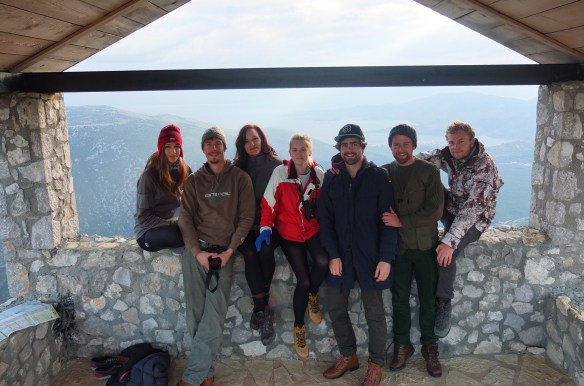
At the height of our power we were many.

At the height of our power we were many.